

A SIP, or Systematic Investment Plan, is a simple way to invest a fixed amount regularly into a mutual fund. For working professionals in India, it can be one of the easiest ways to start investing with discipline, avoid emotional decision-making, and build long-term wealth step by step
When I first heard about SIP, I thought it was some kind of complex financial instrument meant only for people who understood the stock market deeply.If you’re wondering how to start SIP in India, you’ve come to the right place.
I was wrong. SIP — Systematic Investment Plan — is one of the simplest, most powerful tools available to any working professional in India who wants to build wealth slowly and safely.
In this guide, I’ll walk you through exactly what SIP is, why it works, and how you can start one today — even if you’ve never invested before.
What Is SIP and Why Does It Work?
A SIP is a way of investing a fixed amount of money into a mutual fund every month — automatically. Instead of trying to pick the right time to invest (which even experts get wrong), SIP invests your money regularly regardless of market conditions.
This is called rupee cost averaging. When markets are down, your fixed amount buys more units. When markets are up, it buys fewer. Over time, your average cost per unit stays lower than if you had tried to time the market.
For working professionals in India with a fixed monthly salary, this is ideal. You invest once, automate it, and let compound interest do the heavy lifting over years.
How Much Do You Need to Start a SIP?
This is the best part: you can start a SIP in India with as little as ₹500 per month.
That’s less than most people spend on coffee or food delivery in a week. But here’s the thing — starting small and starting early beats waiting until you have “enough money” to invest.
Here’s a simple example of how ₹5,000/month in a SIP grows over time (assuming 12% annual return, which is the historical average for equity mutual funds in India):
- 5 years: ₹1,12,000 invested → ₹1,66,000+ value
- 10 years: ₹6,00,000 invested → ₹11,61,000+ value
- 15 years: ₹9,00,000 invested → ₹25,00,000+ value
- 20 years: ₹12,00,000 invested → ₹49,95,000+ value

Notice how the value more than doubles relative to what you put in, simply because of compounding over time.
Step-by-Step: How to Start a SIP in India
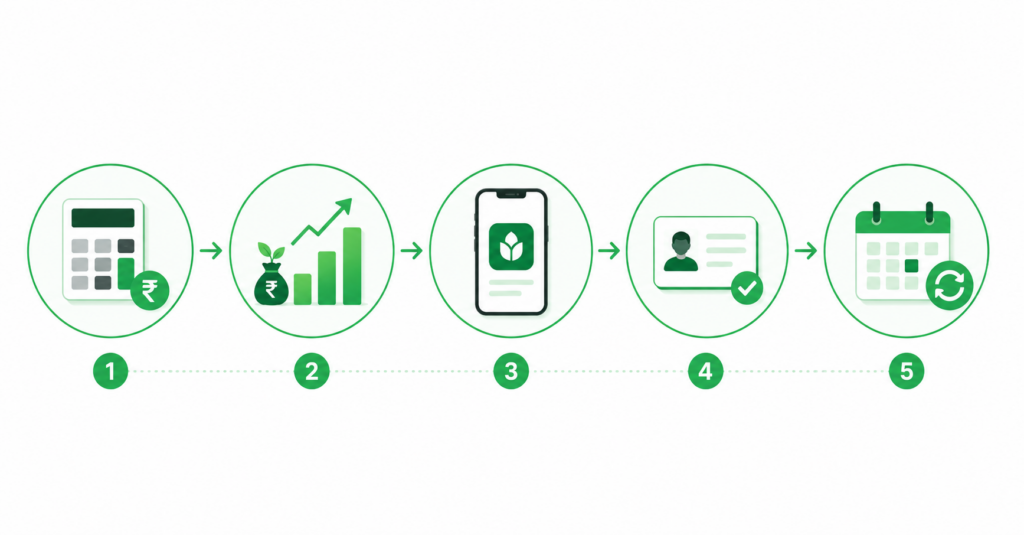
Step 1: Decide how much you can invest each month
Don’t start with a big amount. Start with whatever you can afford without stress. Even ₹1,000 per month is a solid start. The habit matters more than the amount at first.
Step 2: Choose a fund type that matches your goals
For most beginners, an index fund (like Nifty 50) or a flexi-cap mutual fund is the safest starting point. These are diversified, well-managed, and have lower risk than picking individual stocks.
Step 3: Choose a platform to start your SIP
There are several easy platforms available in India:
- Groww – very beginner-friendly, clean interface
- Zerodha Coin – direct mutual funds, no commissions
- Paytm Money – quick to set up if you already use Paytm
- ET Money – great analytics and tracking
All of these allow you to start with direct mutual funds, which means no middlemen and higher returns
Step 4: Complete your KYC (One-time process)
You’ll need your PAN card and Aadhaar for the KYC process. It’s entirely digital now on most platforms and takes about 10 minutes.
Step 5: Set up the SIP and automate it
Once your account is set up, choose your fund, select the SIP date (usually your salary credit date + 3-4 days), and link your bank account. The deduction will happen automatically every month.
Common Mistakes to Avoid When Starting a SIP
Stopping SIP when markets fall: This is the worst mistake. Markets fall — that’s when SIP buys more units at a lower price. The whole system works because of these dips.
Waiting for the “right time”: There is no right time. The right time to start is always now. Even a month’s delay adds up over 20 years.
Investing only in one fund: Diversify across 2-3 funds to reduce risk. For example, one index fund + one flexi-cap fund is a solid combination for beginners.
Not reviewing annually: SIPs work on autopilot, but once a year, review your portfolio. If a fund consistently underperforms its benchmark, switch to a better-performing fund.
SIP vs Lump Sum: Which Is Better for Working Professionals?
Lump sum investing means putting a large amount in all at once. SIP means investing a fixed amount monthly.
For salaried professionals in India, SIP wins every time because:
- You invest from monthly salary (you rarely have a large lump
- It removes the emotional element of timing the market
- It builds a disciplined saving habit automatically
However, if you receive a bonus or inheritance, using that as a lump sum investment alongside your ongoing SIP can accelerate wealth creation significantly
My Personal Experience with SIP

I started my first SIP when I was still figuring out my finances. I had no idea about mutual funds, no broker, and frankly, very little confidence. All i knew was i need to save somewhere, saving in baking looked only beneficial, even i heard they invest our money in stock market funds
I started with ₹3,000 per month in a Nifty 50 index fund. Nothing fancy. Just a consistent, boring monthly investment. but i was doing self stock buying, that everybody does in the beginning trying to out smart the market.
What surprised me most was how little mental energy it required once set up. The money was deducted automatically. I didn’t panic during market corrections because I understood what was happening. I just let it run. on the other hand when we do manual stocks is a headache and waste of energy for most of the Indians because we can never never know what these mutual funds knows and these companies has professional hired to do this right way.
After few years i have realized the peace of mind SIP made more money than what i was trying out smart and time the market can do with no hustle, paper work and capital gain tax issue. That SIP is now one of the best financial decisions I’ve made. And I wish I had started even earlier.
Frequently Asked Questions About SIP in India
Can I stop a SIP anytime? Yes, you can pause or stop a SIP anytime without any penalty. Your already-invested money stays in the fund.
Is SIP safe? SIP in mutual funds carries market risk. However, over the long term (5+ years), equity SIPs have historically generated positive returns in India.
Does SIP give guaranteed returns? No. Returns depend on the mutual fund’s performance. However, index funds closely track the overall market, which has historically grown over time.
What is the minimum SIP amount? Most funds allow ₹100 to ₹500 per month as the minimum SIP amount.
Final Thoughts: Start Your SIP Today
Learning how to start a SIP in India is genuinely one of the easiest things you can do to improve your financial future.
You don’t need to be an expert. You don’t need a lot of money. You just need to start.
If you haven’t built your emergency fund yet, I’d recommend doing that first. Read my guide on building an emergency fund for Indians before starting your SIP, so you’re protected when life throws surprises.
And if you’re looking for a broader overview of safe investing in India, check out my guide on how to start safe investing in India — it covers everything from mindset to mutual funds to long-term wealth building.
Small steps. Consistent action. That’s how real wealth is built.

Abhishek Sikka writes for Indian working adults who want better health habits and safer money decisions. He shares practical lessons from his own lifestyle changes and years of market experience, with a focus on realistic routines, clear thinking, and long-term progress over extremes.
Discover more from
Subscribe to get the latest posts sent to your email.