

Many working professionals earn decent salaries yet still feel financially insecure.
A good income, regular SIPs, and occasional stock investments don’t always create real financial stability. Unexpected medical expenses, job losses, or family emergencies can quickly expose weaknesses in a financial plan.
That’s why safe investing in India is not just about avoiding risk. It’s about building a strong financial foundation that protects your money while helping it grow steadily over time.
If I were starting my investment journey again today, I wouldn’t focus on chasing the highest returns or finding the next market trend. I’d focus on creating stability first.
Because long-term wealth is built by managing risk well, not by taking unnecessary risks.
Before explaining the strategies I’d follow, let me share the moment that completely changed how I thought about money.
The Quiet Moment That Changed How I Thought About Money
I started earning money very early in life—while I was still in school. Growing up in a family with financial challenges, I learned the value of money at a young age. But understanding the value of money and understanding how to grow and protect it are two very different things. It took me many years to learn the second lesson.
In my younger days, I worked extremely hard. I often juggled multiple jobs at the same time, working long hours to earn more. For someone from a middle-class background, earning my own money felt empowering. For the first time, I could buy things I had always wanted but could never afford before. I fulfilled many small dreams and short-term desires that had been out of reach for most of my childhood.
At the time, it felt like success.
But while I was busy earning and spending, I completely ignored two important things: saving and investing.
Money was coming in, and money was going out. As long as my income was growing, I didn’t think much about the future. I believed that hard work alone would always solve my financial problems.
Then life taught me a lesson that almost everyone learns sooner or later.
Bad times eventually arrive.
Unexpected expenses, financial uncertainty, and difficult periods made me realize that earning money is not enough. You also need a financial cushion. That was the moment I understood the importance of saving.
So I started saving.
For a while, I felt proud watching my bank balance grow. I thought I was finally doing the right thing. But after some time, I discovered another problem that I had never considered before: inflation.
The money sitting in my savings account was slowly losing its purchasing power. The amount was increasing, but the real value of that money was quietly shrinking year after year.
That realization pushed me toward investing.
Unfortunately, finding safe investment options was not easy. At that time, the choices I knew about were limited. Real estate seemed to be the preferred investment for most people around me, but it required far more money than I could afford. Then there were countless investment products, schemes, and plans aggressively sold by banks, agents, and financial companies. Many promised high returns, but after digging deeper, I realized that some were expensive products disguised as investments, while others were outright scams.
Like many beginners, I made mistakes.
I followed bad advice. I chased returns. I trusted the wrong people. I lost money in places where I should never have invested in the first place. Every mistake cost me money, but more importantly, it cost me time and peace of mind.
Over the years, through trial and error, successes and failures, I slowly began to understand what safe investing actually means.
I learned that safe investing is not about getting rich quickly.
It is not about chasing the highest returns.
It is not about finding a secret stock tip, a magical mutual fund, or the next investment trend everyone is talking about.
Safe investing is about protecting your hard-earned money, growing it steadily, managing risk, and building financial security for yourself and your family over the long term.
The lessons I know today were not learned from a single book, course, or YouTube video. They were learned through years of experience, mistakes, losses, and observations.
That is why I am writing this guide.
My goal is not to impress you with financial jargon or complicated investment strategies. Instead, I want to share the practical lessons that took me years to learn, so you can avoid some of the mistakes I made and start your investing journey with greater confidence.
If this article helps you save even a few years of confusion, a few costly mistakes, or a significant amount of money, then sharing my story will have been worth it.
Over the last 6+ years of my own journey in trading and investing, I’ve personally experienced both emotional highs and difficult financial lessons. That experience is one reason I strongly believe sustainable wealth matters far more than fast wealth.
If you enjoy practical conversations around trading psychology, investing, and financial discipline, you can also explore my YouTube channel Students of Market
Students of Market by Abhishek Sikka
And if you want to know more about my background and journey, you can also read my
About The Author
Table of Contents
Why Safe Investing in India Matters More Than Ever

A high salary can create the illusion of security.
But income alone doesn’t protect people from financial stress.
Many professionals earning ₹10–25 lakh annually still struggle with money anxiety despite having stable careers and decent lifestyles.
The Financial Problems Most Professionals Quietly Face
- Rising EMIs
- Lifestyle inflation
- Lack of emergency savings
- Credit card debt
- Poor insurance coverage
- Irregular investing habits
- Panic during market downturns
Income Grows — But Expenses Usually Grow Faster

In cities like Gurugram, Mumbai, Bengaluru, and Hyderabad, expenses rise almost automatically with income.
A salary increase slowly turns into:
- A bigger apartment
- More expensive gadgets
- Premium subscriptions
- Frequent food delivery
- International vacations
- Higher social expectations
The problem is not enjoying life. The problem is building a lifestyle that depends entirely on uninterrupted salary income.
That’s why layoffs, health emergencies, or market downturns feel terrifying even for people who appear financially successful from the outside.
What Real Financial Stability Looks Like
Real financial stability is usually built on:
- Liquidity
- Disciplined savings
- Long-term investments
- Protection against emergencies
- Emotional control during market volatility
Safe investing begins with understanding this difference.
What Safe Investing in India Actually Means

Safe investing in India does not mean keeping all your money in a savings account.
And it definitely does not mean avoiding wealth creation altogether.
Safe investing simply means building wealth in a way that helps you sleep peacefully at night.
It focuses less on chasing maximum returns and more on reducing the chances of financial damage caused by panic, poor decisions, or unnecessary risk.
Safe Investing in India Is About Surviving Bad Times
Most people only think about investing during bull markets.
But real investing discipline is tested during:
- layoffs
- market crashes
- medical emergencies
- business slowdowns
- unexpected life expenses
For example, during the COVID-19 lockdown, millions of people faced job losses and stock markets fell sharply. Many investors panicked and sold their investments at a loss. In contrast, those who had a strong financial foundation were able to stay invested or even buy more while prices were down. Over time, they were often the ones who benefited the most from the market recovery because they weren’t forced to make decisions out of fear or financial pressure.
A safe investment strategy is designed to survive these situations without destroying your long-term financial stability.
That’s the difference between investing aggressively and investing sustainably.
Safe Investing in India Usually Includes
- Emergency fund before aggressive investing
- Diversified investments instead of “all-in” bets
- Long-term SIP investing
- Adequate health and term insurance
- Avoiding unnecessary debt
- Realistic return expectations
- Emotional discipline during market volatility
Safe investing is often slower.
But for most salaried professionals, slower and sustainable usually wins over fast and stressful.
The Goal Is Freedom, Not Constant Stress

Many people unknowingly turn investing into another source of anxiety.
They constantly:
- check stock prices
- react to financial news
- compare returns with others
- panic during corrections
- chase trending investments
Over time, this creates emotional exhaustion.
Safe investing takes a different approach.
The goal is not to impress people with short-term returns.
The goal is to gradually build a financial life where unexpected situations no longer feel devastating.
Investing vs Speculation — Understand the Difference
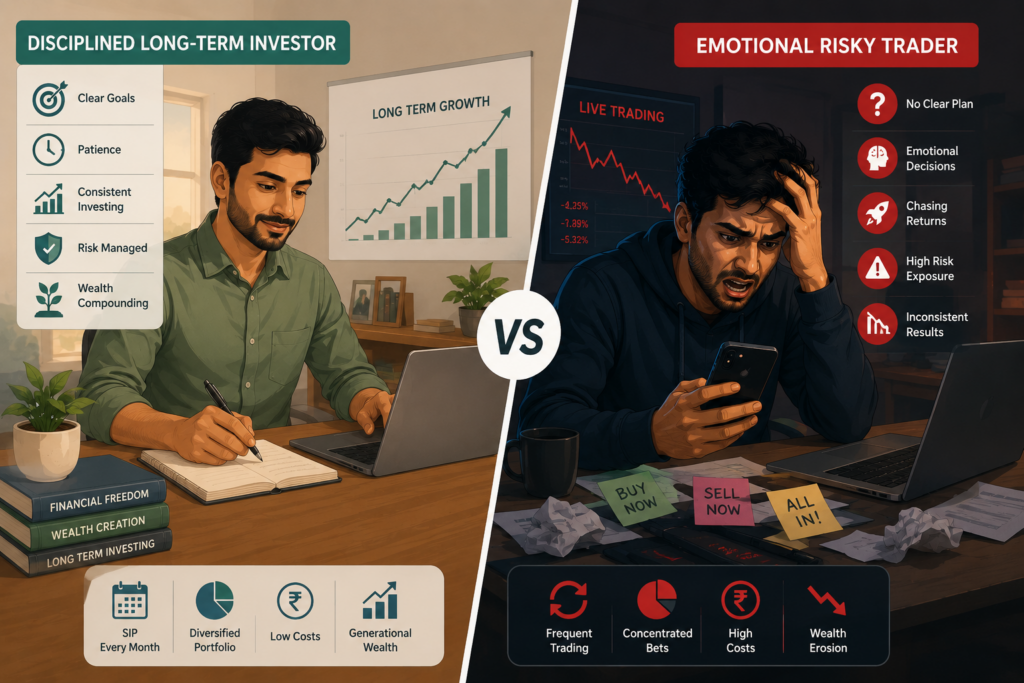
This distinction matters more today than ever before.
Many people think they are investing when they are actually speculating.
And in the age of social media, the line between the two has become dangerously blurry.
What Investing Usually Looks Like
Investing focuses on building wealth slowly and sustainably over time. The goal is not quick excitement.
The goal is long-term financial growth with controlled risk.
Safe investing in India usually involves:
- Diversification
- Consistent investing habits
- Long-term thinking
- Patience during market ups and downs
- Reasonable return expectations
Common examples include:
- Index funds
- SIPs in mutual funds
- EPF and PPF
- NPS
- Government bonds
- High-quality long-term businesses
Index funds are my personal first choice for long-term, peace-of-mind investing. When you invest in a broad market index fund, you automatically gain exposure to many of the strongest companies in the economy. For most people who do not come from a finance background, this removes the need to constantly track company earnings, management changes, or quarterly results.
The index is regularly reviewed and updated, so weaker companies gradually get replaced by stronger performers over time. This allows investors to benefit from the overall growth of the economy without having to become stock-picking experts.
Even Warren Buffett has repeatedly suggested that most people are better off investing through low-cost index funds rather than trying to beat the market. While no investment guarantees returns, history has shown that many actively managed investors struggle to consistently outperform broad market index funds over long periods.
That simplicity, diversification, and low maintenance are the main reasons index funds remain my preferred choice for long-term wealth creation.
This approach may feel slow in the beginning. But over long periods, disciplined investing often outperforms emotional decision-making.
What Speculation Usually Looks Like
Speculation focuses more on short-term price movements and quick profits.
It is often driven by:
- hype
- fear of missing out
- market excitement
- social media trends
Examples include:
- Frequent trading
- Leverage trading
- Meme stocks
- Random crypto bets
- “Guaranteed” stock tips
- Chasing trending investments without research
Speculation is not always wrong.
But problems begin when people take high risks without understanding the downside.
Investing vs Speculation
| Investing | Speculation |
| Long-term | Short-term |
| Lower stress | Emotion-driven |
| Diversified | Concentrated bets |
| Patience | Excitement |
The Internet Often Rewards Excitement, Not Stability
Online financial content usually highlights dramatic success stories.
You will constantly see:
- overnight trading profits
- screenshots of massive returns
- viral stock picks
- luxury lifestyles linked to investing
What people rarely show are:
- heavy losses
- emotional stress
- debt taken for trading
- years of inconsistent returns
Safe wealth-building usually looks boring from the outside.
“The goal is not to become rich quickly. The goal is to become financially difficult to break.”
But boring is often sustainable.
And sustainable is what helps people build real financial stability over time.
Step 1: Build an Emergency Fund First

This is the part most people skip.
And later, it becomes the reason they panic during financial emergencies.
An emergency fund is not just “extra savings.”
It is your financial shock absorber.
Without emergency savings, even small setbacks can force people into bad financial decisions like:
- Breaking long-term investments
- Taking expensive personal loans
- Depending heavily on credit cards
- Selling investments during market crashes
That’s why safe investing starts with stability first — not aggressive returns.
How Much Emergency Savings Should You Have?
Emergency Fund Targets for Most Professionals
A practical target for most Indian professionals is:
- Minimum: 6 months of essential expenses
- Ideal: 9–12 months if you have dependents, EMIs, or an unstable job situation
For example:
If your household spends around ₹60,000 per month, your emergency fund should ideally be:
- ₹3.6 lakh minimum
- ₹5–7 lakh for stronger financial security
The goal is simple:
You should be able to survive temporary financial disruption without panic.
Where Should Emergency Money Be Kept?
Emergency money should focus on three things:
- Liquidity
- Safety
- Quick accessibility
Auto-Sweep Account (My Preferred Option)
An Auto-Sweep Account combines the flexibility of a savings account with the higher interest of a Fixed Deposit (FD).
Here’s how it works:
- You set a minimum balance limit, say ₹20,000.
- Any money above that amount is automatically moved into an FD and starts earning higher interest.
- If you need money later, the bank automatically breaks only the required portion of the FD and transfers it back to your savings account.
Example:
Suppose your salary is credited and your account balance becomes ₹50,000.
- The bank keeps ₹20,000 in your savings account.
- The extra ₹30,000 is automatically moved to an FD.
A few days later, if you need ₹35,000 for an emergency purchase:
- The bank automatically transfers ₹15,000 from the FD back into your account.
- Your payment goes through without any manual action.
Why I Like It:
- Higher returns than a regular savings account.
- Instant access to money during emergencies.
- No need to manually create or break FDs.
- Keeps your emergency fund liquid while making idle cash work harder.
For most people, an Auto-Sweep Account is a simple way to keep emergency money accessible without sacrificing returns.
Other good options include:
- High-interest savings accounts
- Liquid mutual funds
- Short-term fixed deposits
Where Not to Keep Your Emergency Fund
- Stocks
- Real estate
- Long lock-in investments
- Highly volatile assets
Your emergency fund is not meant to generate exciting returns.
Its real purpose is something far more valuable:
Time, flexibility, and peace of mind.
I’ve written a detailed guide on building an emergency fund in India here.
Step 2: Protect Yourself Before Chasing Returns

Many professionals spend years focusing on investments while ignoring financial protection.
That creates a dangerous imbalance.
Because wealth-building is not only about growing money.
It is also about protecting what you’ve already built.
One serious medical emergency, accident, or unexpected loss of income can wipe out years of savings surprisingly fast.
That’s why safe investing should begin with three priorities:
- Health insurance
- Term life insurance
- Emergency liquidity
Only after building this foundation should you start taking higher investment risks.
Why Health Insurance Matters Even If Your Employer Already Covers You?
“One Medical Bill Away From Bankruptcy”
To a financially unaware person, life may seem perfectly stable. There is a regular salary coming in, bills are being paid on time, and some money is being saved every month.
But the reality is that many families are standing on a financial tightrope.
If a serious illness, surgery, or accident suddenly happens, the hospital bill can wipe out years of savings within days. Families are often forced to break investments, sell gold, borrow money, or take on debt that takes years to repay.
This is not a rare situation. According to data cited by the World Health Organization (WHO) and several economic studies, nearly 5–6 crore Indians are pushed into poverty every year because of unexpected healthcare expenses.
That is why financial security is not just about growing wealth. It is about making sure that one bad event does not destroy everything you have worked for.
Many salaried professionals assume their company health insurance is enough.
Often, it isn’t.
Employer insurance usually comes with limitations:
- Coverage may be too low for major treatments
- Protection disappears if you lose your job
- Parents or family members may not be adequately covered
- Some treatments and hospitals may have restrictions
And medical inflation in India keeps rising every year.
A single hospitalization in a private hospital can easily cost several lakhs.
That’s why having a personal health insurance policy creates something important:
Independent financial protection.
You are not depending entirely on your employer for medical security.
Term Insurance Is About Responsibility, Not Returns
If your family depends on your income, term insurance is essential.
The purpose is simple:
To protect your family financially if something happens to you.
This is not an “investment.”
Mixing term insurance with investments
One of the biggest financial mistakes many Indians make is mixing insurance with investing.
Products like ULIPs, endowment plans, and money-back policies are often sold as “the best of both worlds” — investment plus insurance. In reality, several studies and industry reports have highlighted widespread mis-selling of such products across India.
A well-known study by the Indira Gandhi Institute of Development Research (IGIDR) estimated that Indian consumers collectively lost around ₹1.5 lakh crore because of poorly understood and mis-sold life insurance investment products. Many people stopped paying premiums after a few years and faced heavy surrender penalties, losing a large part of their savings.
Consumer surveys have also found that a significant percentage of insurance buyers felt they were misled about product benefits, returns, or policy terms. Insurance grievance data in India repeatedly shows that mis-selling remains one of the most common complaints in the industry.
The reason is simple:
These products often generate high commissions for sellers while offering:
- Lower transparency
- Complex structures
- Modest long-term returns
- Inadequate life cover for families
A pure term insurance policy works differently.
It is not an investment.
It is a financial safety net.
If your family depends on your income, your primary goal is not generating returns from insurance. Your goal is ensuring that your family remains financially protected if something happens to you.
Insurance is for protection. Investments are for wealth creation.
Keep them separate.
Buy term insurance for financial security, and use investments like mutual funds, PPF, EPF, NPS, or index funds for long-term wealth creation.
That approach is usually simpler, more transparent, and financially healthier over the long run.
In many cases, simple term plans are:
- More affordable
- Easier to understand
- More transparent
- Better focused on actual protection
Safe investing is not just about earning returns.
It is about reducing the financial damage that unexpected events can create.
Step 3: Start With Simple, Low-Stress Investments
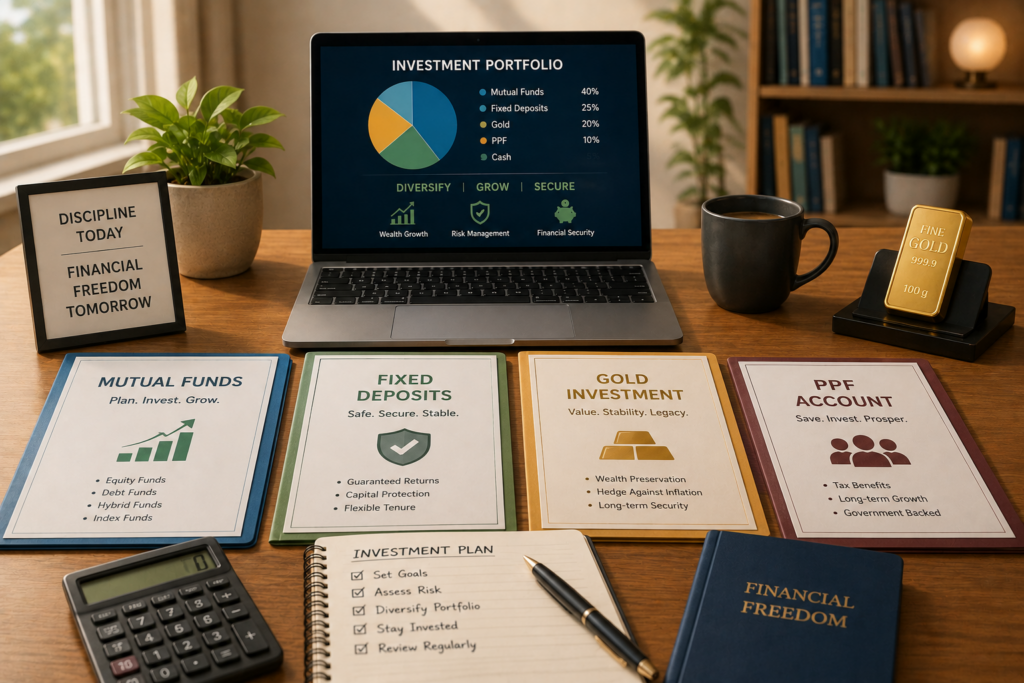
You do not need complicated strategies to build wealth.
In fact, complexity often creates confusion, inconsistency, and unnecessary stress.
Many successful long-term investors follow surprisingly simple systems for decades.
The goal of safe investing is not to constantly chase the highest possible returns.
The goal is to build wealth steadily while still being able to sleep peacefully at night.
Here are some of the most practical low-stress investment options for Indian investors.
1. EPF (Employees’ Provident Fund)
For salaried professionals, EPF is one of the safest long-term wealth-building tools available.
It offers several major advantages:
- Government-backed structure
- Tax benefits
- Long-term compounding
- Forced investing discipline through salary deductions
Many people underestimate how powerful EPF can become over 20–25 years of consistent contributions.
What feels like a small monthly deduction today can grow into a significant retirement corpus over time.
2. PPF (Public Provident Fund)
PPFPPF continues to remain a strong option for conservative investors.
Its biggest strengths include:
- Government-backed safety
- Tax-free maturity benefits
- Stable long-term compounding
- Lower emotional stress during market volatility
The lock-in period can actually become an advantage.
It discourages impulsive withdrawals and encourages long-term thinking.
For investors who value stability and predictability, PPF remains a reliable part of a balanced portfolio.
3. Index Fund SIPs
For most people, index fund SIPs are one of the simplest and most practical ways to participate in long-term market growth.
Instead of trying to constantly pick winning stocks, index funds simply track broader markets such as:
- Nifty 50
- Sensex
This approach offers several advantages:
- Diversification
- Lower costs
- Reduced decision fatigue
- Simpler investing experience
- Long-term growth potential
For busy professionals, this is often far more sustainable than constantly researching stocks or reacting to market news every day.
Consistency usually matters more than complexity.
4. NPS (National Pension System)
NPS can work well as a retirement-focused investment tool.
It is especially useful for:
- Long-term retirement planning
- Additional tax benefits
- Disciplined asset allocation
NPS should not replace all other investments.
But it can complement a diversified portfolio designed for long-term financial stability.
5. Fixed Deposits
FDs Fixed deposits may not generate aggressive wealth growth, but they still serve an important role in safe investing.
FDs can provide:
- Stability
- Predictable returns
- Capital protection
- Support for short-term financial goals
A balanced investor understands that not every rupee needs to maximize returns.
Some money should maximize peace of mind.
An Auto-Sweep Account combines the flexibility of a savings account with the higher interest of a Fixed Deposit (FD).
The Bigger Lesson
Safe investing is often less exciting than what social media promotes.
There are no dramatic overnight success stories.
No constant adrenaline.
No obsession with daily market movements.
But simple, disciplined investing done consistently for years is how many people quietly build real financial security.
Why SIP’s Work Better Than Waiting for the “Perfect Time”

One of the biggest mistakes people make is delaying investments because markets “feel expensive.”
The reality is simple:
Nobody consistently predicts market movements accurately.
Even experienced investors and professionals struggle to time markets perfectly over long periods.
That is exactly why SIPs work so well.
What Is a SIP?
A SIP (Systematic Investment Plan) allows you to invest a fixed amount regularly into mutual funds.
For example:
- ₹5,000 monthly
- ₹10,000 monthly
- ₹20,000 monthly
Regardless of whether markets are rising or falling.
This creates two powerful habits:
- Consistency
- Discipline
Instead of making emotional decisions based on headlines or market fear, SIPs help investors stay invested through different market cycles.
The Power of Rupee Cost Averaging
SIPs naturally use a concept called rupee cost averaging.
Here’s how it works:
- When markets fall, your SIP buys more units
- When markets rise, your existing units increase in value
Over time, this helps smooth out the impact of short-term volatility.
Rather than fearing market corrections, long-term SIP investors gradually learn to see them as a normal part of the wealth-building journey.
Small SIPs Can Grow Significantly Over Time
Many people underestimate how powerful consistency can become over long periods.
Even moderate monthly investments can potentially compound into meaningful wealth over 15–25 years.
A SIP calculator helps visualize this clearly.
You can experiment with:
- Monthly investment amount
- Expected return rate
- Investment duration
to understand how long-term compounding works.
The Biggest Advantage of SIPs Is Psychological
The true strength of SIP investing is not just mathematics.
It is behavioral simplicity.
SIPs reduce:
- Emotional decision-making
- Fear during market crashes
- Greed during bull markets
- Constant market monitoring
For busy professionals, this low-stress approach is often far more sustainable than trying to actively trade or predict short-term market movements.
The investor who stays consistent for 20 years usually performs better than the investor constantly waiting for the “perfect entry point.”
Compounding Rewards Patience
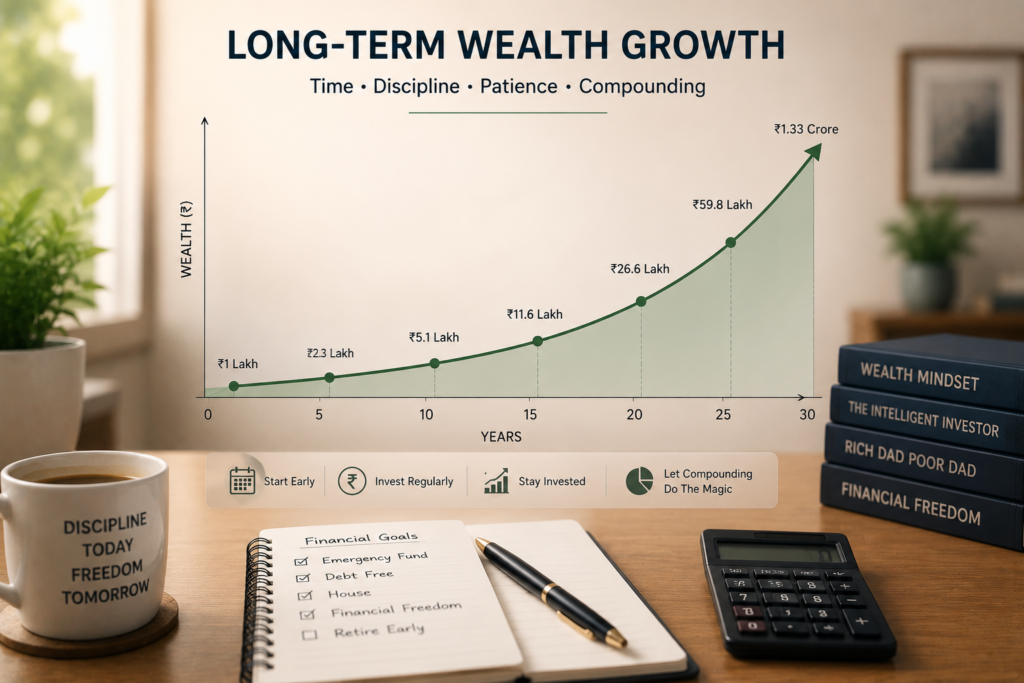
One of the most powerful concepts in investing is compounding.
Small, consistent investments can become surprisingly large over long periods of time.
For example:
A=10000⋅120.12(1+120.12)12⋅20−1 – refer to the SIP calculator
A monthly investment of ₹10,000 over 20 years at moderate long-term returns can potentially grow into a significant corpus.
The important lesson is not chasing extraordinary returns or trying to get rich quickly.
The real advantage comes from:
Staying invested during market cycles
- Time
- Consistency
- Staying invested during market cycles
Compounding Starts Slowly, Then Accelerates
In the early years, investment growth may appear small.
That often discourages people.
But compounding behaves differently over long periods.
The longer money stays invested, the more returns begin generating additional returns.
This creates a snowball effect.
Most wealth creation happens slowly at first and then accelerates significantly in later years.
That is why investors who start early often have a major advantage over those who delay investing by even a few years.
Time in the Market Matters More Than Timing the Market
Many people spend years waiting for:
- The perfect market correction
- Higher income
- Better economic conditions
- More confidence
Meanwhile, they lose valuable compounding time.
Even modest investments started early can outperform larger investments started much later.
Consistency usually matters more than intensity.
The investor who stays disciplined for 20–25 years is often in a far stronger position than someone constantly changing strategies or chasing short-term returns.
Common Investment Mistakes Indian Professionals Make

Most financial problems do not come from lack of intelligence.
They usually come from emotional decision-making.
Even highly educated professionals often struggle with consistency, patience, and risk management.
Here are some of the most common investing mistakes.
1. Chasing Trends Instead of Building Systems
Every few years, a new “guaranteed wealth” trend appears:
- Crypto mania
- Penny stocks
- Options trading
- Viral investment apps
- Social media stock tips
People often enter late after hearing success stories.
By then, risk is already extremely high.
Safe investors avoid excitement-driven investing.
2. Investing Without an Emergency Fund
This creates fragile finances.
Without emergency savings:
- Market corrections become emotionally unbearable
- Investors panic and sell too early
- Long-term plans collapse during emergencies
- Debt increases during unexpected situations
Emergency funds provide emotional and financial stability.
When investors know they have liquidity available, they are less likely to make impulsive decisions during market volatility.
A strong financial foundation improves investment behavior.
3. Taking Excessive EMIs
A high salary can make large EMIs feel manageable.
But excessive fixed obligations reduce flexibility.
Sometimes buying on EMI can be beneficial because banks and credit cards offer attractive discounts on EMI transactions. However, the discount is only genuinely valuable if you already have enough money in your bank account to buy the product outright. If you need EMI because you cannot afford the purchase in cash, the discount often becomes a trap that encourages unnecessary spending.
Large EMIs can force people to:
- Stop investing
- Break emergency savings
- Exit investments early
- Increase credit card debt
Safe investing also means controlling liabilities.
A balanced lifestyle creates better long-term financial stability than constantly upgrading expenses with every salary increase.
4. Stopping SIPs During Market Crashes
This is extremely common.
Ironically, market downturns are often when future long-term returns improve.
But fear causes many investors to stop SIPs at exactly the wrong time.
SIPs work best when continued across:
- Bull markets
- Bear markets
- Economic uncertainty
- Temporary volatility
During corrections:
- SIPs buy more units
- Average purchase costs improve
- Long-term compounding benefits increase
Consistency matters more than confidence.
Investors who continue disciplined investing during difficult periods often benefit the most over long time horizons.
5. Following Influencers Blindly
Financial content online can be useful.
But many creators optimize for:
- Attention
- Viral engagement
- Excitement
- Fear
- Aggressive claims
Not necessarily long-term financial well-being.
Always ask:
- Does this advice fit my risk tolerance?
- Does it match my financial goals?
- Can I emotionally handle the downside risk?
- Would I still feel comfortable if markets dropped sharply?
Good investing should help you sleep peacefully.
If an investment constantly creates anxiety, stress, or emotional instability, the risk may already be too high for your situation.
A Simple Safe Investing Framework for Busy Professionals
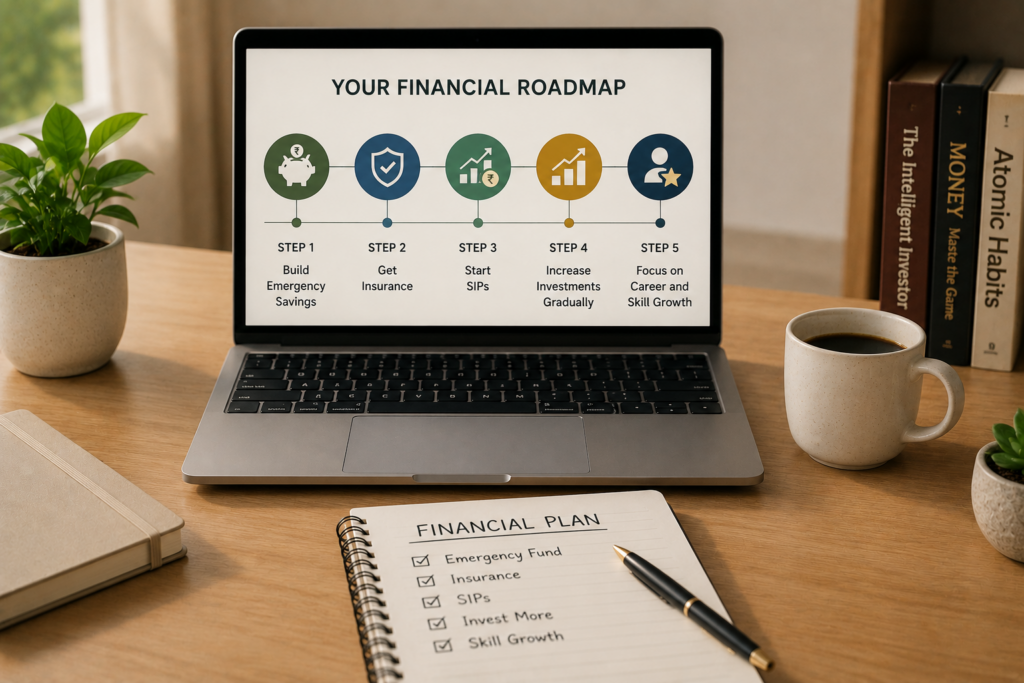
You do not need 15 different investments.
You need a financial system you can follow consistently for years without stress.
Simple systems are usually easier to maintain during both good and bad market conditions.
Here’s a practical framework many working professionals can adapt.
Step 1: Emergency Fund
Target:
- 6–12 months of expenses
Purpose:
- Handle unexpected emergencies
- Reduce dependence on loans or credit cards
- Prevent panic-selling investments during crises
- Create emotional stability during uncertainty
Your emergency fund should ideally remain in:
- High-quality savings accounts
- Liquid mutual funds
- Short-term fixed deposits
Pro tip – Auto-Sweep Account is a very good peace of mind option for emergency funds
This money is not for wealth creation.
It is for financial protection.
A strong emergency fund gives investors confidence to stay invested for the long term.
Step 2: Insurance Protection
Priority:
- Health insurance
- Term life insurance
Purpose:
- Protect long-term savings
- Reduce catastrophic financial risk
- Prevent medical emergencies from destroying investments
Pro tip – Never mix insurance with investments
Many professionals focus heavily on investing while ignoring risk protection.
But one major medical emergency or unexpected event can erase years of savings.
Insurance is not an investment.
It is financial defense.
Good financial planning always starts with protecting downside risk first.
Step 3: Long-Term Core Investments
Suggested allocation examples:
- EPF/PPF for stability
- Index fund SIPs for growth
- NPS for retirement
- FDs for short-term needs
The exact ratio depends on:
- Age
- Risk tolerance
- Family responsibilities
- Income stability
The goal is not maximizing returns at any cost.
The goal is building sustainable long-term financial security.
Step 4: Increase Investments With Salary Growth
Many people increase lifestyle spending after every increment.
A smarter approach is increasing investments gradually as income rises.
For example:
- Increase SIPs gradually with salary hikes
- Automate investments
- Avoid unnecessary lifestyle inflation
Even a 10–15% yearly increase in investments can significantly improve long-term outcomes because of compounding.
Small disciplined increases over time often matter more than trying to find “perfect” investments.
Step 5: Focus on Career and Skill Growth
Your earning ability is also a financial asset.
Often, the best investment in your 20s and 30s is improving your income potential.
This can include:
- Learning new skills
- Improving communication abilities
- Building industry expertise
- Expanding professional networks
- Becoming more valuable in your field
Higher earning capacity creates stronger investing ability over time.
Long-term wealth creation usually becomes easier when both:
- Income grows steadily
- Financial discipline improves simultaneously
Safe investing is not only about market returns.
It is also about building a stable, resilient financial life.
Safe Investing Is Also About Mental Health

Interestingly, financial stability and personal well-being are closely connected. Consistent routines, healthier lifestyle habits, and reduced stress often improve long-term decision-making. If you’re interested, you can also read my article on daily habits for a healthier and more balanced life.
Money stress affects far more than bank balances.
It can impact:
- Sleep
- Relationships
- Productivity
- Confidence
- Emotional well-being
That’s why investing should reduce anxiety over time — not increase it constantly.
If your investments make you:
- Panic daily
- Obsessively track markets
- Lose sleep
- Feel emotionally unstable
…then your financial system may be too aggressive for your personality and risk tolerance.
A good investment strategy should support long-term stability, not constant emotional pressure.
The best investing approach is usually not the most exciting one.
It’s the one you can follow consistently during both good and bad periods.
You Don’t Need to Become Rich Overnight
Social media has distorted financial expectations.
Many people now expect:
- Instant success
- Rapid wealth creation
- Unrealistic early retirement timelines
- Constant high returns
But sustainable wealth usually grows quietly.
It grows through:
- Discipline
- Time
- Patience
- Consistent habits
- Avoiding major financial mistakes
Most financially secure people are not constantly chasing the next opportunity.
Instead, they focus on fundamentals like:
- Saving consistently
- Investing patiently
- Controlling debt
- Living below their means
- Staying invested for long periods
That approach may appear slow in the beginning.
But over decades, it becomes extremely powerful because of compounding and financial discipline.
What Financially Secure People Do Differently
They are simply:
- Saving consistently
- Investing patiently
- Controlling debt
- Living below their means
- Staying invested long enough
That approach may look slow.
But over decades, it becomes powerful.
The Real Goal: Financial Calm
At its core, safe investing is not really about impressing people with returns.
It is about creating a life with:
- Less panic
- More flexibility
- Better family security
- Freedom to handle uncertainty
- Confidence during difficult periods
Financial calm is underrated.
Being able to:
- Handle emergencies
- Survive temporary setbacks
- Avoid toxic debt
- Sleep peacefully during market volatility
…is a form of wealth many people only appreciate later in life.
You do not need the most aggressive portfolio.
You do not need to outperform everyone around you.
You simply need a sustainable financial system that helps you move steadily toward long-term stability.
Because ultimately, the purpose of investing is not to impress people online.
It is to build a life that feels secure, balanced, and resilient in the real world.
Final Thought
You do not need perfect timing.
You do not need to become rich quickly.
You do not need to impress social media.
You simply need a financial system you can continue following for decades.
That is how real wealth is usually built.
Slowly.
Quietly.
Consistently.
Let’s Talk
I’m curious:
What is the biggest financial challenge or investing fear you personally struggle with right now?
Is it:
- starting late,
- market crashes,
- low savings,
- risky investments,
- debt pressure,
- or simply not knowing where to begin?
FAQs About Safe Investing in India for Professionals
Is SIP really safe for beginners?
SIPs are considered one of the safer ways to start investing because they promote disciplined investing over time instead of emotional market timing. However, mutual funds still carry market risk, so investors should choose funds based on their risk tolerance and goals.
How much should I invest monthly in SIPs?
A good starting point is an amount you can continue consistently without financial stress. Even ₹2,000–₹5,000 monthly can become meaningful over long periods due to compounding.
Should I stop SIPs during market crashes?
Many long-term investors continue SIPs during market declines because lower prices allow accumulation of more units. Historically, consistency during volatile periods has often benefited patient investors.
Is FD better than mutual funds?
Both serve different purposes.
- Fixed Deposits offer stability and predictable returns.
- Mutual funds offer better long-term growth potential but involve market fluctuations.
A balanced financial plan may include both.
How much emergency fund should working professionals keep?
Most financial planners recommend maintaining 6–12 months of essential expenses in liquid savings or low-risk instruments.
Can investing improve financial stress?
A structured financial system often reduces uncertainty over time. Emergency savings, manageable debt, insurance protection, and long-term investing can improve financial confidence and emotional stability.
Is it too late to start investing in your 30s?
No. Starting late is usually better than delaying further. While early investing has advantages, disciplined investing in your 30s and 40s can still create meaningful long-term wealth.
Should beginners avoid stock trading?
For most busy professionals, long-term investing through diversified instruments like index funds is often simpler and emotionally easier than active trading. Trading requires skill, risk management, and emotional discipline.
What is the safest investment option in India?
There is no single “perfectly safe” investment. Different instruments serve different purposes:
- EPF/PPF → stability
- FDs → liquidity and predictability
- Index funds → long-term growth
- NPS → retirement planning
Safety usually comes from diversification and sensible allocation, not from one product alone.
Research & Studies
Vanguard Research on Long-Term Investing
Highlights the effectiveness of diversification, disciplined investing, and staying invested during volatility.
DALBAR Quantitative Analysis of Investor Behavior (QAIB)
Shows how emotional investing and panic decisions often reduce long-term investor returns.
SPIVA Reports (S&P Indices Versus Active Funds)
Repeatedly show that many active fund managers underperform index funds over long periods.
Warren Buffett’s 2013 Berkshire Hathaway Shareholder Letter
Buffett recommended low-cost index funds for most long-term investors.
Behavioral Finance Research by Daniel Kahneman & Amos Tversky
Their work demonstrated how emotions and cognitive biases affect financial decision-making.
Disclaimer
This article is for educational and informational purposes only and should not be considered personalized financial advice. Investment decisions should be made based on your own financial situation, goals, and risk tolerance. Consider consulting a qualified financial advisor before making major investment decisions.
If you truly read till here, I know you are serious about changing something.
Tell me in the comments: which one of these four areas—morning, food, exercise, or sleep—feels most broken for you right now, and what is one small change you’re willing to try this week?
Leave a comment below — I genuinely read them, and your question might also help someone else facing the same situation.

Abhishek Sikka writes for Indian working adults who want better health habits and safer money decisions. He shares practical lessons from his own lifestyle changes and years of market experience, with a focus on realistic routines, clear thinking, and long-term progress over extremes.
Discover more from
Subscribe to get the latest posts sent to your email.