
Many of us reach a point in our working lives—usually between the ages of 25 and 45—where a single salary begins to feel tight. Between surging home loan EMIs, children’s school tuition, ageing parents’ healthcare costs, and the persistent desire to build something of our own, we start actively scanning the horizon for an extra income stream.
If you spend any time browsing the Indian internet or social media feeds lately, you have likely run into bold, polished advertisements promising low-risk, high-return entrepreneurial paths: “Start your own delivery franchise business in India, earn ₹50,000 every month, and capitalize on India’s booming e-commerce logistics wave!” For a salaried professional looking for a secure anchor to escape the corporate grind or diversify their income, a courier franchise business in India sounds like the ultimate “safe” business bet. After all, you don’t have to invent a brand from scratch; there is an established system, a recognizable logo, and the comforting pitch of “be your own boss with a proven model” already laid out for you.
But before you sign that long-term legal agreement and hand over your hard-earned life savings, let’s have a transparent, human-to-human reality check. To separate corporate sales pitches from ground reality, I have spent weeks diving deep into raw, firsthand interviews with seasoned franchise owners and industry veterans who live and breathe this trade daily. This includes insights from:
- Mr. Hukum Singh, who transitioned from a corporate job to launch Perfect Courier & Cargo (a prominent DTDC franchise setup).
- Mr. R.S., the owner of Pawan Express, who started working in the logistics trade back in 1993 before starting his own franchise agency.
- Mr. Kaushal Sharma, the founder of Shipclues, an independent tech-driven logistics aggregator platform.
The unfiltered truth? Operating a franchise in the logistics sector is not just about neatly booking packages over a counter. It is an operationally heavy, gritty, and margin-thin business that demands your direct presence on the field every single day. It comes with a cocktail of daily headaches—from missing parcels and rider attrition to furious customer complaints at 9 PM—that the glittering recruitment brochures never mention.
This comprehensive guide is designed for ordinary working Indians who want objective clarity, not a glossy sales pitch. Let’s peel back the layers on how the logistics industry actually works on the ground so you can decide if it truly aligns with your capital, your risk appetite, and your lifestyle goals.
Table of Contents
What Is a Franchise Business in India?
In simple terms, stepping into a franchise business mode in India is like purchasing a “business-in-a-box”. When you start an independent company from the ground up, you have to spend years investing capital and sweat equity to earn public trust, establish operational frameworks, and build a brand identity. With a franchise model, you circumvent that initial phase by paying an established parent company (the franchisor) a fee to instantly leverage their corporate reputation, proprietary software systems, and national distribution infrastructure.Beginner’s guide to franchise opportunities in India
In the context of the Indian logistical landscape, your role as a franchisee is that of an operational “facilitator”. As Mr. Kaushal Sharma elegantly explains, because individual e-commerce sellers or retail customers cannot easily interface with massive national distribution networks on their own, the local franchise acts as the critical bridge connecting the sender to the grand machinery of domestic transportation. You manage the localized micro-operations (handling customer walk-ins, commercial bookings, physical sorting, and last-mile execution), while the parent network handles the long-haul interstate transport, line-haul flights, and core technological backend.
Franchise business opportunities in India broadly span across several well-defined operational formats depending on your budget, space, and target customer segment:
- Counter Booking Outlets (Retail Points): This is the entry-level model where you set up a small commercial shop primarily to accept retail packages, weigh them, collect payments, and book them into the company’s system. It requires low capital but relies heavily on high foot traffic.
- Delivery-Focused Hubs: Here, your primary mandate is last-mile fulfillment. The parent company dumps hundreds of parcels meant for your specific pin codes at your facility every morning, and your team of delivery agents must sort and distribute them to households.
- Composite/Comprehensive Hubs: A hybrid model that handles both bulk retail booking and area-wide delivery operations. This is the model operated by established players like Mr. Hukum Singh and Mr. R.S., scaling up both revenue potential and operational complexity.
- Logistics & 3PL (Third-Party Logistics) Franchises: A broader model that goes beyond standard documents and small parcels to manage bulk commercial cargo, heavy B2B freight, warehousing solutions, and supply chain fulfillment for local Small and Medium Enterprises (SMEs).
While names like DTDC, Blue Dart, Professional Couriers, and Trackon dominate traditional retail courier circles, aggressive tech-first delivery networks like Delhivery, XpressBees, Shadowfax, and Ecom Express have expanded the ecosystem significantly through localized delivery partner and hub models.
Why Courier and Logistics Franchises Are Attracting Attention
The surging interest in the delivery franchise business model across India is not an accidental trend; it is the direct byproduct of a massive structural shift in how our country consumes goods. Over the last decade, logistics has transformed from a dusty, backend corporate function into the visible, frontline pulse of the Indian economy.
There are four primary macroeconomic drivers causing salaried professionals and aspiring investors to look closely at logistics franchise business in India opportunities:
- The Unstoppable E-Commerce Wave: Online shopping has broken out of the elite circles of Tier-1 metros. Today, a staggering volume of daily digital transactions originates from Tier-2 and Tier-3 cities. Millions of regional consumers are purchasing apparel, electronics, and household goods online, turning every small town into an active delivery node.
- The Standard of Instant Gratification: Customer expectations have permanently shifted. Same-day or next-day delivery is no longer treated as a premium luxury; it is the baseline expectation. To hit these aggressive timelines, national carriers cannot rely on a few centralized warehouses—they require hyper-localized partners who can process parcels immediately on arrival.
- National Infrastructure Expansion: Massive public and private investments in highways, dedicated freight corridors, digitized transit systems, and massive warehousing hubs have drastically accelerated transit speeds. This infrastructure acts as a high-speed conveyor belt across India, but it still needs a localized “off-ramp” to complete the final loop.
- The “Last-Mile” Dependency Trap: This is where the franchise model becomes indispensable. No matter how multi-billion-dollar a national logistics giant is, its corporate machinery cannot effectively navigate the complex lanes, localized addresses, and regional nuances of every single pin code on its own. They are deeply dependent on local entrepreneurs who own the ground execution.
On paper, this creates a beautifully logical narrative: India is moving more boxes than ever before, so owning a piece of that box-moving machinery looks like a guaranteed path to steady revenue. However, before concluding that market demand equals easy profitability, we must examine the unvarnished day-to-day operational realities of running these centers.
Ground Reality: Courier Franchise Owners Share Their Experience in India
To pull back the corporate veil, I sat down for long, candid conversations with three individuals who deal with the brutal, unvarnished mechanics of Indian logistics every day. Their experiences reveal a sharp contrast between what you read in a sleek franchise brochure and what actually happens on the office floor.
Instead of presenting an edited summary, I have structured their core insights into interactive breakdowns below. Click on each panel to read the exact operational realities, struggles, and real-world advice they shared from their journeys.
- The Onboarding Background: Mr. Singh spent decades gaining deep operational experience as a salaried employee inside multiple logistics companies, including Trackon. In 2017, he finally decided to leverage his domain knowledge to set up his own DTDC franchise in Faridabad.
- The Zero-Income Year: His first major reality check was the stabilization timeline. “Ek saal humne kaam kiya, ek saal to hume kuch nahi mila. Jeb se hi laga, ghar ka kharcha,” he shared. For a full twelve months, the business generated zero net profit. He had to fund both office overheads and personal household expenses entirely out of his past savings.
- The Routine Ground Hustle: There is zero marketing support provided by the corporate brand parent. Mr. Singh has to build his entire client pipeline manually through localized Google promotions and physically pounding the pavement doing door-to-door B2B sales pitch meetings inside local industrial clusters. He warned that generic lead-generation networks like Justdial resulted in heavy financial losses with almost entirely fake inquiries.
- The Daily Firefighting: His typical day is dominated by high-stress customer complaints regarding delayed shipments, customs hold-ups on international parcels, or items missing in transit. He notes that while the corporate system offers carrier risk protection at roughly 2% of product value, most local retail clients flatly refuse to pay it to save pennies, leaving the franchise owner to absorb the emotional friction and legal threats when a crisis hits.
- The Multi-Decade Journey: Mr. R.S. began his career inside the courier trade back in 1993. After dedicating seven to eight years gaining hands-on corporate experience, he branched out to establish his independent DTDC franchise agency, Pawan Express.
- The Working Capital Strain: Just like Mr. Singh, he highlighted a prolonged 2-to-3-year timeline of continuous financial survival using personal savings and external loans before the business comfortably stabilized. Cash flow is a massive headache because the business runs heavily on credit (udhaar). While you have to extend loose payment terms to keep local clients happy, the parent network demands strict settlements on fixed timelines.
- The Squeezed Volume Game: He highlights that the modern courier model has evolved into a hyper-competitive volume game with microscopic margins. “Aaj ke time mein sirf volume pe hai. Agar volume hai to thoda bahut kama sakte ho, otherwise margin kam hai,” he noted.
- The Brutal Advice: When asked if he would encourage a family member or an ambitious newcomer to invest in a courier franchise today, his response was immediate and blunt: “Mat kara. Agar experience nahi hai to. Pehle job करिए…” He explained that modern customers believe paying ₹1 gives them total ownership of your life, resulting in aggressive midnight phone calls over tracking delays that make the industry emotionally draining.
- The Corporate Veteran View: To view the industry from a macro perspective, I spoke with Mr. Kaushal Sharma, a seasoned corporate professional who previously served as the Chief Financial Officer (CFO) for Shein India. After the brand was restricted, he studied global logistics networks and launched Shipclues in 2022 as a tech-driven aggregator platform that acts as an operational facilitator connecting e-commerce sellers with various national delivery carriers.
- The Deflationary Margin Paradox: Mr. Sharma highlighted a terrifying trend that defies basic economics: logistics is one of the only industries where structural costs (such as fuel and labor) are inflating rapidly, yet per-parcel market rates are steadily dropping due to cutthroat price wars. For instance, a standard 250-gram shipment segment that previously commanded a sustainable rate of ₹32 has been aggressively squeezed down to just ₹25 including GST.
- The Return to Origin (RTO) Nightmare: He pointed out that the single greatest financial drain for logistics operators and online sellers alike is the RTO percentage. If a Cash on Delivery (COD) parcel is rejected at the customer’s doorstep, the business has to bear the two-way freight costs without generating a single rupee of revenue, turning logistics operations into a highly risky balancing act.
- The Modern Warning: Mr. Sharma believes the golden era of the traditional small-scale courier franchise business in India has largely passed. He notes that regional aggregators are burning cash blindly to buy market share, and he explicitly advises salaried professionals against jumping into this field simply because they see multi-crore giants succeeding from far.
Before you invest even ₹1 in a franchise setup, ensure you have a fully-stocked emergency fund as a working professional — because in this business, your personal savings will be your lifeline in the early months.
Investment, Revenue Potential, and Day-to-Day Operations
If you want to transition from a salaried job into this space, you need to understand the dry, hard numbers and operational realities. Logistics is a game of pennies, and your survival depends entirely on managing leaking margins.
Typical Investment Requirements
The capital required to establish a courier franchise business in India generally falls into two categories, depending on the scale of your territory and the brand power of the franchisor:
- The Lean Counter Setup (₹1.5 Lakh – ₹4 Lakh): This is a micro-franchise model (like a standard DTDC or XpressBees retail outlet). It requires a tiny retail commercial footprint of roughly 60–100 sq ft. The capital primarily covers the initial brand security deposit, basic counter interiors, a computer, a thermal printer, barcode scanners, an official weighing scale, and minor exterior signage.
- The Comfortable Delivery/Composite Hub (₹5 Lakh – ₹15 Lakh): If you target an enterprise model or an exclusive territory with a tech-first player like Delhivery, the cost jumps significantly. This setup requires a larger space (200–300+ sq ft) to sort bulk incoming parcels. The capital is deployed toward higher security deposits, warehouse racking systems, advanced tech infrastructure, and security cameras. Most importantly, it requires a substantial cash buffer to sustain operations during the early months.
Before committing your savings to any business venture, make sure you have a solid financial foundation — read our guide on safe investing in India to understand how to protect your capital first.
The Two-Column Overview: Ground Reality vs. My Final Take
To help you see past the marketing brochures, let’s lay out the operational components using a structured, transparent comparison:
| Operational Component | 1) Ground Reality | 2) My Final Take |
| Staffing Needs & Retention | Most standard setups require 3–5 people, including an office coordinator and field riders. On-the-ground industry data shows a staggering 30–50% monthly attrition rate among delivery riders due to intense pressure, long hours, and complex target structures. | Managing a blue-collar team is a gritty, exhausting skill that corporate managers underestimate. If two of your riders abruptly quit on a festive morning, your operations stall immediately. You must be mentally prepared to step out and deliver parcels yourself to protect your client contracts. |
| Revenue Streams & Pricing | Your income is derived as a margin slab—typically ranging from 15% to 35%—representing the difference between what the parent brand charges you and what you bill the end client. This includes retail walk-ins, local B2B corporate contracts, and occasional high-ticket international shipments. | Retail walk-ins offer high margins but low volumes. B2B clients offer massive volumes but will squeeze your pricing down to the absolute bone. It is an aggressive balancing act where you must continuously chase volume just to clear your fixed monthly liabilities. |
| The Silent Profit Killers | Monthly gross margins are systematically eaten away by post-reconciliation charges from the parent hub. These include weight discrepancies (where automatic hub scanners claim your parcel was heavier than logged, billing you the difference), Out-of-Delivery-Area (ODA) fees, and volatile monthly fuel surcharges that frequently jump from 30% to over 50%. | These hidden deductions are the number one reason franchise centers bleed money. Because local market competition is fierce, you often cannot pass sudden fuel hikes or weight penalties onto your B2B corporate clients. You are forced to absorb these losses directly out of your net profit. |
Day-to-Day Responsibilities
If you expect this to be an investment where you look at a dashboard twice a week while relaxing at home, the reality on the ground will shock you. A typical day for an owner-operator looks like this:
- 07:30 AM – 10:00 AM: Opening the facility, receiving the incoming line-haul trucks from the parent company, supervising the physical sorting of hundreds of parcels, checking rider attendance, and planning routes.
- 10:00 AM – 02:00 PM: Managing walk-in retail clients, monitoring live tracking systems for stuck shipments, and resolving immediate delivery failures.
- 02:00 PM – 06:00 PM: Stepping out into the field. Both Mr. Singh and Mr. R.S. emphasized that you must personally visit local factories, retail shops, and commercial offices door-to-door to pitch your services and win high-volume B2B accounts.
- 06:00 PM – 09:00 PM: Processing outgoing packages, ensuring accurate labeling, handling cash and Cash-on-Delivery (COD) reconciliations, and answering tense phone calls from customers whose parcels are delayed.
This kind of 6-to-7-day workweek demands strong physical and mental endurance. Building simple daily habits for a healthy life is not optional — it is essential survival for any entrepreneur in this space.
Risks and Challenges
Before you take the leap from your corporate desk, you must look closely at the structural landmines built into the logistics ecosystem. Every industry has risks, but in a courier franchise business in India, your profits are highly exposed to external forces that you cannot control.
Here are the five critical challenges that keep franchise owners awake at night:
- Cutthroat Competition and Squeezed Margins: The entry barrier for small-scale courier outlets is low, which means local markets are heavily saturated. To win high-volume B2B accounts from local factories or e-commerce sellers, competing agencies aggressively slash their per-parcel rates. As Mr. Kaushal Sharma highlighted, when a market segment drops from a comfortable ₹32 down to a razor-thin ₹25 due to price wars, your room for error completely vanishes. You find yourself working twice as hard just to make the same amount of money.
- The Volatility of Fuel Surcharges: Your primary cost base is tied directly to transportation. When global or domestic fuel prices rise, your parent company immediately imposes a monthly fuel surcharge (often fluctuating between 30% and 60%). Because your contracts with local business clients are usually fixed, you cannot easily pass these sudden cost hikes onto them. This creates an immediate cash flow leakage that eats directly into your net margins.
- Punitive Corporate SLAs and Policy Dependency: As a franchisee, you are completely at the mercy of the parent company’s policies, technology updates, and Service Level Agreements (SLAs). If the franchisor’s national tracking system goes down or a major regional transit hub suffers a strike, your local deliveries will stall. Your customers will blame you, not the corporate brand. Furthermore, if corporate support is weak during transit crises, you bear the emotional and operational stress alone.
- The Operational Nightmare of Customer Complaints: In this business, if you deliver 99 parcels perfectly but delay just one, that single delayed package becomes your entire focus for the day. When high-value shipments go missing or get damaged in transit, customers do not gently wait for an email response. They will show up at your retail office furious. Both Mr. Singh and Mr. R.S. noted that despite legal liabilities officially sitting with the customer if they decline insurance, owners face extreme local pressure, constant screaming, and even police FIR threats.
- The Constant Strain of Working Capital: A massive trap for corporate professionals is underestimating cash flow friction. Most B2B clients and industrial accounts demand credit terms (udhaar), expecting monthly billing cycles with 15 to 30 days to clear invoices. However, your operational expenses—like shop rent, utility bills, electricity, and daily rider fuel allowances—must be paid out in hard cash every single day. If your clients delay their monthly payments by even two weeks, your working capital can snap, forcing you to fund the business out of your personal pocket.
Who Should Start a Courier Franchise Business in India?
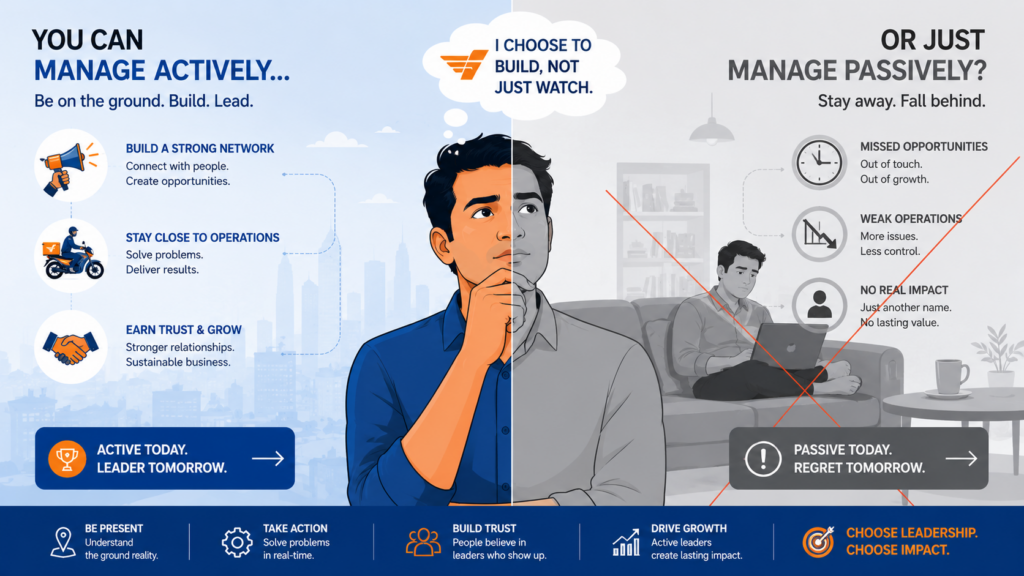
Investing your capital in a logistics franchise India model should not be an emotional decision; it requires a specific alignment of your personality, daily energy, and financial buffer. Based on the deep operational realities shared by veteran franchise owners, this business path is best suited for individuals who match the following criteria:
- The On-the-Ground Operational Manager: This business belongs to those who thrive on real-world movement, physical execution, and solving unpredictable logistical problems in real time. If you enjoy being on your feet, optimizing local delivery routes, and actively coordinating with team members, you will fit naturally into this role.
- The Proactive Local Networker: A massive portion of your recurring revenue hinges on your personal capacity to generate local volume. You must be completely comfortable walking door-to-door into local manufacturing units, corporate offices, and e-commerce warehouses to pitch bulk dispatch services and build long-term B2B commercial relationships.
- The Emotionally Resilient Firefighter: You need to possess a thick skin and a calm mind under intense pressure. Because delayed shipments, damaged goods, and frantic customer phone calls are a routine part of daily operations, you must be capable of de-escalating tense human situations without absorbing the emotional stress.
- The Financially Patient Planner: This model is for individuals who have a secure secondary income source or a deep financial runway. You must be financially equipped to survive 1 to 2 full years where the franchise generates little to no personal profit while it slowly stabilizes its local volume and clears fixed overhead costs.
Who Should Avoid This Business?
To protect your hard-earned savings, it is equally vital to identify who should completely steer clear of the delivery franchise business model:
- The Passive Income Investor: If you are a salaried professional looking for a “hands-off” asset where you simply deposit money, hire a manager, and wait for monthly dividends to hit your bank account, stay far away. Both franchise owners and platform founders warn that without your direct, daily physical supervision, cash leakages and rider operational chaos will bleed the business dry within months.
- The Corporate Desk Enthusiast: If you prefer highly predictable, structured, and entirely digital work environments—where all interactions happen over clean emails or video calls—the gritty, chaotic ground reality of blue-collar labor management and retail customer arguments will quickly exhaust you.
- The Quick-Returns Chaser: If your investment thesis requires hitting break-even within the first six months or pulling out heavy profits in Year 1 to fund your lifestyle, this industry will disappoint you. The initial stabilization phase is long, slow, and highly capital-demanding.
Step-by-Step Process to Apply for a Courier and Logistics Franchise
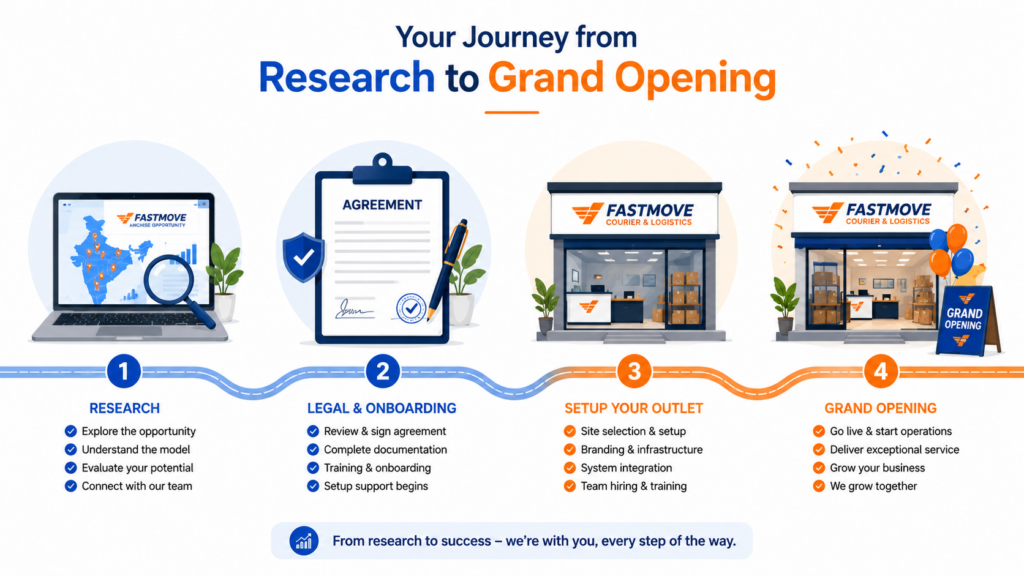
If you have carefully evaluated your financial runway, lifestyle goals, and risk tolerance, and you still believe this hands-on model aligns with your strengths, you can systematically navigate the application process using this structured, high-level roadmap:
- Step 1: Conduct Intensive Localized Market Research: Before approaching any corporate entity, spend a few weeks mapping out your target city or neighborhood. Identify existing commercial hubs, upcoming residential complexes, and manufacturing clusters. Spend time visiting operational franchise outlets anonymously as a retail customer to observe their daily foot traffic, parcel mix, and service efficiency firsthand.
- Step 2: Initiate Official Corporate Enquiries: Once you have narrowed down a primary territory, navigate to the official corporate portals of your shortlisted brands. Fill out their formal franchise query forms, detailing your available capital, proposed shop location, and professional background. Avoid dealing with third-party brokers or unofficial middleman websites to protect your information and capital.
- Step 3: Execute Strict Operational Due Diligence: When a regional manager from the parent company reaches out with a business prospectus, look past the glossy profit projections. Ask hard, explicit questions regarding territorial boundaries, local weight discrepancy rules, actual fuel surcharge calculations, and real-world claims resolution timelines for lost packages.
- Step 4: Formulate a Realistic Investment and Buffer Plan: Build a comprehensive financial spreadsheet that extends far beyond the initial franchise fee. Account for shop lease advances, interior renovations, IT hardware setups, initial staff salaries, and at least six months of liquid operational working capital. Assume that your personal take-home profit from the business in Year 1 may be zero.
- Step 5: Submit Formal Documentation for Site Approval: File your formal application along with required KYC documents, bank financial statements, GST registration papers, and geotagged photographs of your proposed commercial site. The parent company’s regional operations team will physically inspect your location to verify accessibility, visibility, and market viability.
- Step 6: Complete Software Training and Onboarding: Upon receiving formal location clearance and executing the legal franchise agreement, you and your core office team will undergo mandatory operational training. This phase covers mastering the franchisor’s proprietary booking and tracking software, volumetric weight calculations, and standard labeling protocols.
- Step 7: Execute a Strategic Soft Launch: Begin operations without an expensive advertising blitz. Start by servicing nearby walk-in clients, tapping into your personal professional network, and visiting local traders door-to-door to refine your operational workflows, stabilize rider management, and minimize early service errors.
Franchise Application Resources (Official Company Portals)
To assist your initial research phase, here are the direct, official corporate enrollment portals for the major national logistics and express delivery networks in India:
- DTDC Franchise Application: https://www.dtdc.in/
- Blue Dart Registration: https://www.bluedart.com/registrationform
- Delhivery Partner Program: https://www.delhivery.com/partner
- XpressBees Franchise Partner: https://www.xpressbees.com/partner/franchise-partner
Important Operational Note: Use these corporate resources exclusively to study formal brand compliance, infrastructural benchmarks, and official fee structures. Always cross-verify these corporate figures with the ground realities shared by live franchise owners before executing payments.
Pros and Cons of a Courier Franchise Business in India
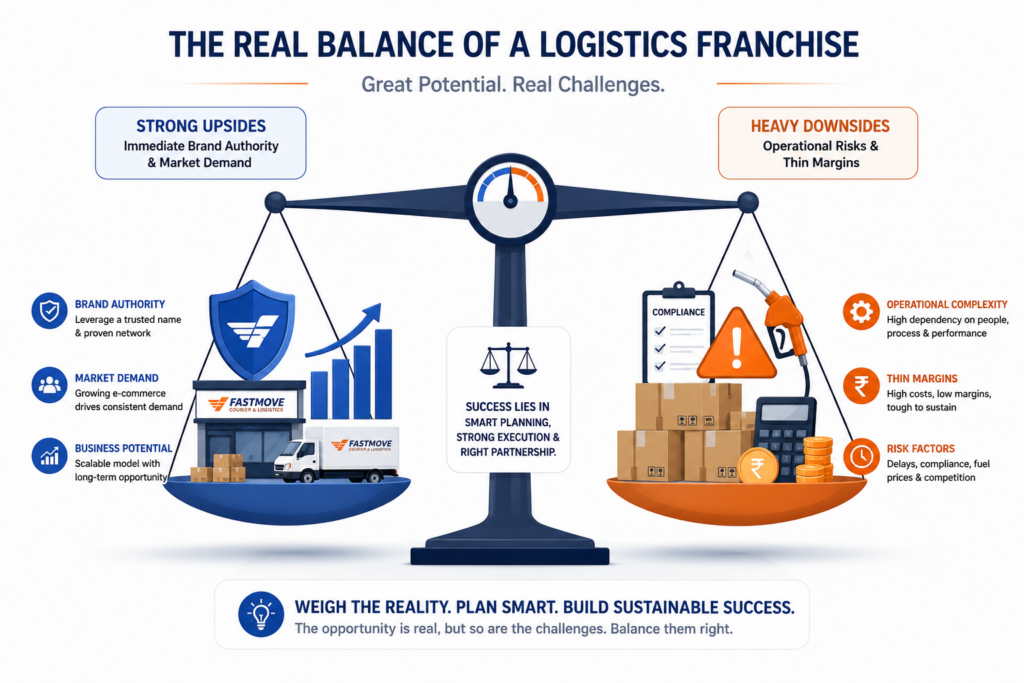
To synthesize everything we have covered so far, let’s look at the ultimate trade-offs of this business model at a glance:
| Business Aspect | Pros | Cons |
| Capital & Entry Barriers | Lower initial capital compared to industries like manufacturing or food retail; a basic retail outlet can be launched with relatively minimal infrastructure. | True working capital needs and long stabilization timelines (1 to 3 years) are routinely underestimated by beginners. |
| Brand Leverage | Immediate access to an established corporate reputation, a ready-made national distribution network, and specialized logistics software. | Absolute dependence on parent company policies, tracking systems, and varying levels of corporate customer support. |
| Market Demand | Direct alignment with India’s booming e-commerce ecosystem and rising last-mile delivery volumes across Tier-2 and Tier-3 cities. | Highly commoditized market where aggressive local price wars continuously squeeze per-parcel margins. |
| Operational Control | High-velocity, day-to-day operational business that provides immediate, tangible cash flow once volumes are established. | Drastic margin exposure to external profit killers like fuel surcharges, weight discrepancy penalties, and costly RTO fees. |
| Lifestyle & Management | Ideal for hands-on, execution-oriented individuals who enjoy real-world problem-solving and people management. | Physically and mentally draining; involves managing high-churn blue-collar staff and handling aggressive customer complaints late into the night. |
FAQ: Commonly Searched Questions
1. How much can I realistically expect to earn from a courier franchise business in India?
While glossy franchise advertisements often throw around figures in lakhs, the reality on the ground is far more modest in the early stages. Most independent, single-outlet franchise owners report a net take-home profit of roughly ₹20,000 to ₹40,000 per month during the first few years after fully clearing operational costs like rent, salaries, and fuel. Earnings only scale higher if you manage to lock in high-volume, recurring B2B corporate accounts within your designated territory.
2. How long does it take for a new logistics franchise center to stabilize?
According to the firsthand experiences of veteran owners, the stabilization timeline typically spans 1 to 3 years. It is common to earn absolutely nothing from the business during your first year, forcing you to pay for your household expenses and business overheads entirely out of personal savings while you slowly build a local client base.
3. Does the parent corporate brand provide direct marketing support?
Practically speaking, no. While the corporate franchisor provides the national network, the branding logo, and the digital booking system, they will not bring individual customers to your office door. Generating local shipping volumes relies entirely on your personal hustle—including local Google promotion, distributing pamphlets, and visiting factories door-to-door.
4. What are the biggest “hidden costs” that destroy profitability?
The most frequent profit killers are weight discrepancy charges (where corporate sorting hubs re-weigh your packages automatically and bill your wallet for any difference), Out-of-Delivery-Area (ODA) surcharges, and volatile monthly fuel surcharges that can instantly eat up 20% to 40% of your expected shipping margin if not precisely tracked and managed.
5. Can I run a courier franchise as a hands-off side business while keeping my day job?
Realistically, this is a recipe for financial failure. A courier hub or booking office is an intensely active operational business that demands real-time problem solving, staff supervision, and daily client interactions. Unless you have an exceptionally trustworthy, highly skilled business partner or full-time manager on the floor, it cannot be run on autopilot as a passive investment.
6. What happens if a high-value parcel goes missing or gets damaged in transit?
If the shipment was booked under corporate “carrier risk” (which requires an extra premium of roughly 2% of the declared product value), the parent company initiates a standard verification and compensation claim process. However, because most local retail customers refuse to pay this extra fee, the package is processed at “no risk”. When a crisis hits, the legal liability may sit with the customer, but the intense local friction, anger, and operational stress land squarely on the franchise owner’s shoulders.
7. Should I jump directly into a franchise setup or work a job in logistics first?
Every single experienced operator and industry expert interviewed shared the exact same advice: do not jump in blind. If you do not have personal experience in logistics, spend 2 to 3 years working a job inside the industry first. Learning how to handle rider management, weight reconciliations, and customer conflicts using someone else’s capital is the safest way to prepare for entrepreneurship.
Final Thoughts: Trust Your Reality, Not the Brochure
Is a Courier Franchise Business in India Right for You?
When you look at the macro picture, a courier franchise business in India remains a perfectly legitimate, time-tested vehicle for self-employment and local entrepreneurship. It taps into a genuinely growing national e-commerce story, requires relatively accessible entry-level capital, and leverages established technology networks.
However, it is vital to remember that it is not a shortcut to easy wealth, nor is it a magical engine for passive income. It is a highly competitive, operationally intense, and margin-thin trade that requires sharp discipline, constant personal presence, and a long financial runway to survive the initial years of ground-level friction.
Respect the massive machinery that keeps India’s parcels moving every day, but respect your own life stage, savings buffer, and daily energy limits equally before making your final decision.
Reader Reflection Question:
Am I looking for an active, on-the-ground business opportunity that I can build through daily personal sweat equity, or am I actually looking for a passive investment vehicle that requires very little of my direct time and involvement?
The completely honest answer to this single question should determine whether a courier franchise is truly the right anchor for your entrepreneurial journey.
Keep following AbhishekSikka.com for more transparent, deeply researched, ground-level business insights and unfiltered operator interviews.
This article came out of a direct, confidential conversation with a courier franchise operator, part of an ongoing project where I talk to real business owners across India about what actually running their business looks like. If you run a courier, logistics, franchise, distribution, or manufacturing business and are open to a conversation, I would love to hear from you — reach out here.
If you truly read till here, I know you are seriously considering this decision — not just chasing a brochure.
Tell me in the comments: which part of this worries you most right now — the upfront investment, the franchisor’s promises, or your own ability to run day-to-day operations? And if you already run a courier or logistics franchise, what would you tell someone before they sign?
Leave a comment below — I genuinely read them, and your experience might save someone else from a costly mistake.

Abhishek Sikka writes for Indian working adults who want better health habits and safer money decisions. He shares practical lessons from his own lifestyle changes and years of market experience, with a focus on realistic routines, clear thinking, and long-term progress over extremes.
Discover more from
Subscribe to get the latest posts sent to your email.