
Building sustainable sleep habits for working professionals is often the hardest challenge after 30. Right after school, like many coming from a lower-middle-class background, the most promising and accessible career path for me was a BPO call center. The package felt unbeatable: a decent salary, office meals included, and company cabs picking you up and dropping you off right at your doorstep. In a Tier-2 setup back then, the concept of a vibrant nightlife was rare—and getting a taste of it felt exciting.
But that lifestyle came with a heavy, hidden tax: my sleep.
For 12 years, I rotated through almost every shift imaginable—US night shifts, UK hours, Australian timings, afternoon schedules, and brutal 5:00 AM rosters where the alarm rang at 2:00 AM. Over time, I convinced myself that living on minimal rest was a superpower. I told myself, “Since I’m already comfortable staying up all night, I can work more hours to earn extra money, and on weekends, stay up even later to party and socialize.”
The real breakdown hit after 30.
Suddenly, the endless energy vanished. I struggled with daily focus, morning brain fog, and a sharp decline in mental clarity. I realized that my body was no longer forgiving the years of sleep neglect. Before I could fix my career, fitness, or daily productivity, sleep had to be the very first foundation to rebuild.
I dug deep into research, books, clinical journals, and podcasts to understand the science of rest. I began actively tracking my sleep metrics, testing habits, and building firm daily boundaries. Once I stabilized my sleep, everything else—my focus, physical energy, and productivity—naturally fell right back into place.
If you are past 30 and waking up feeling drained, here are the most effective sleep habits for working professionals to help you reclaim your rest.
Table of Contents

Key Takeaways
- Poor sleep after 30 is a combination of biological changes, rising workplace stress, and unmanaged evening stimulation.
- More than 60% of Indians get less than 6 hours of sleep, directly impacting productivity and mental health.
- Effective sleep habits for working professionals focus on damage control: setting a fixed wake-up time and cutting caffeine 8 hours before bed.
- Cooling your bedroom and building a 10-minute screen-free wind-down routine are proven ways to rebuild deep sleep.
- Loud snoring and daytime exhaustion are not just signs of aging; they are red flags for sleep apnea, which affects over a third of the population.
The Ground Reality of Indian Workplaces
The most important thing to understand is that poor sleep in India is a systemic issue tied to our workloads, stress levels, and urban routines. When we look at the reality of sleep habits for working professionals in India, the numbers are eye-opening.
A pooled review of 100 Indian studies estimated insomnia prevalence at a staggering 25.7%. The same review found that Obstructive Sleep Apnea (OSA) prevalence was 37.4%. This is critical because unrecognised sleep apnea often masquerades as “just poor sleep” or “stress fatigue.” You might think you are just tired from work, but your body is actually fighting for oxygen multiple times an hour.
For salaried adults, the pressure is incredibly acute. Reporting around India’s workplace culture shows that long workweeks remain the norm, with more than 51% of Indian employees working over 49 hours per week. It is no surprise that in a recent workplace health survey, 71% of Indian workers said insufficient sleep hurts their productivity. The lived experience matches the data: another report found that 61% of respondents got less than 6 hours of uninterrupted sleep.
Financial anxiety is another massive, silent driver of sleep debt. When your mind is racing late at night over EMIs, family security, or whether you have a sufficient emergency fund for Indians, your nervous system stays locked in a state of high alert. Gaining control over your money through safe investing in India and understanding how to start a SIP in India doesn’t just build long-term wealth—it removes chronic mental friction, finally allowing your brain to shut down and rest.
Why Sleep Breaks Down After 30

In your twenties, you could eat a heavy meal at midnight, sleep for five hours, and still function. After 30, the biology of sleep changes. Work and family demands peak simultaneously, leaving you with zero personal time during the day. This leads to “revenge bedtime procrastination”—staying up late just to have an hour to yourself.
Additionally, recovery from stress becomes slower. Many of us gain weight as our metabolism shifts and desk jobs keep us sedentary. This weight gain increases the likelihood of snoring and sleep-disordered breathing. Finally, our coping mechanisms—late-night screen use, extra cups of tea or coffee, and heavy late dinners—become deeply ingrained habits rather than occasional indulgences.
Biggest Traps and Counterproductive Advice
There is a lot of terrible sleep advice out there. Let’s clear up what actually works and what is actively harming your rest.
| Common Sleep Myth | The Reality After 30 |
|---|---|
| “I can catch up on sleep on the weekends.” | You can reduce immediate sleep debt slightly, but you cannot fully reset your circadian rhythm or restore lost cognitive function with one long Sunday sleep. |
| “I only need 5 to 6 hours now that I am used to it.” | Habitual short sleep feels normal only because you adapt to the feeling of being tired. Your actual performance, memory, and health are still heavily compromised. |
| “A heavy dinner is fine if I eat it by 9 PM.” | In many working households, 9 PM is too close to an 11 PM bedtime. Late, spicy, or oily meals trigger acid reflux, physical discomfort, and lighter, fragmented sleep. |
| “Late coffee is fine because I fall asleep anyway.” | Falling asleep is not the same as sleeping well. Caffeine reduces deep sleep and increases night awakenings even if you manage to doze off initially. |
Falling asleep is not the same as sleeping well. Exhaustion might knock you out, but if caffeine or stress is still in your system, it won’t give you the deep, restorative sleep your brain needs to clear the fog.
A Practical Step-by-Step Framework for Busy Professionals
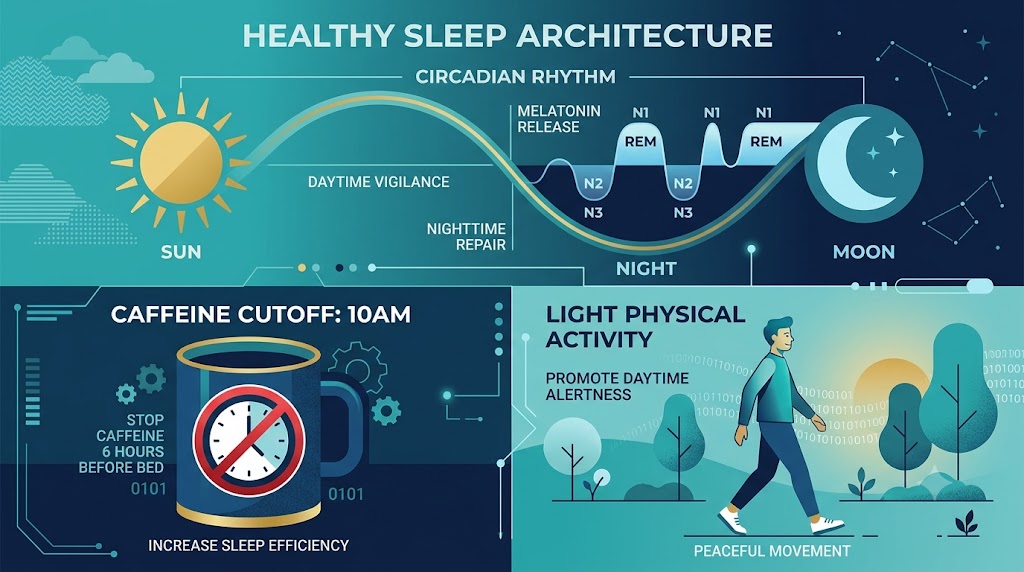
The most effective sleep habits for working professionals focus on damage control. You do not need a perfect 10-step wellness routine; you need reliable boundaries. Here is a realistic framework.
Step 1: Set a Non-Negotiable Sleep Window
Stop worrying about what time you go to bed and start focusing on what time you wake up. Pick a fixed wake-up time for weekdays and stick to it. Work backward to establish a realistic bedtime that gives you at least 7 hours of opportunity to sleep. Protect this window fiercely. Consistency anchors your circadian rhythm.
Step 2: Time Your Caffeine Properly
Caffeine is a powerful drug with a long half-life. A recent evidence review found that while small doses might be tolerated closer to bedtime, larger doses within 12 hours clearly worsened sleep, with significant fragmentation if taken within 8 hours. For most professionals, the practical rule is to stop all caffeine 8 hours before bed. Remember that strong tea, cola, and pre-workout supplements all count.
Step 3: Cut Stimulation 60 Minutes Before Bed
Indian studies consistently link evening screen exposure with delayed sleep onset and poorer sleep quality. It is not just the blue light; it is the emotional stimulation. Reading a stressful work email at 10 PM floods your body with cortisol. Turn off work chats, dim the overhead lights, and keep the last 30 to 60 minutes screen-free.
Step 4: Make Dinner Lighter and Earlier
Our culture often revolves around heavy, late dinners. Aim to finish eating at least 2 to 3 hours before bed. Keep late meals lighter, lower in fat, and less spicy. If a long commute forces a late dinner, drastically reduce the portion size and skip the heavy sweets. Your digestive system needs to rest so your core body temperature can drop.
Step 5: Cool the Bedroom and Your Body
A cooler bedroom helps the body lower its core temperature, which is a biological requirement for sleep onset and deep sleep. Use a fan, set the AC to a comfortable cool temperature, and use breathable cotton bedding. A warm shower an hour before bed can also help; as the water evaporates off your skin, it triggers a rapid drop in body temperature, signaling to your brain that it is time to sleep.
Step 6: Build a 10-Minute Wind-Down Routine
You cannot sprint at 100 miles per hour all day and expect to hit the brakes instantly at 11 PM. Create a short, predictable sequence you do every single night. Wash your face, dim the lights, put the phone in another room, and do some light reading or deep breathing. This signals to your brain that the workday is officially over.
Step 7: Watch for Medical Red Flags
If you are doing everything right and still waking up exhausted, you need to look for medical red flags. If you experience loud habitual snoring, gasping for air during sleep, severe morning headaches, or excessive daytime sleepiness, please see a doctor. As mentioned earlier, sleep apnea affects over a third of the population and requires medical intervention, not just better habits.
Frequently Asked Questions
Why does sleep seem so much worse after 30?
It is a perfect storm. Stress loads increase, screen exposure is constant, caffeine dependence grows, and our physical recovery capacity naturally declines. Additionally, weight changes in our thirties often increase the risk of snoring and sleep apnea.
Does caffeine after lunch really affect sleep if I fall asleep fine?
Yes. Evidence shows that even if you fall asleep, caffeine in your system reduces the amount of deep sleep you get and increases micro-awakenings throughout the night. You wake up feeling unrefreshed because your sleep architecture was fragmented.
Are sleep tracking apps on smartwatches accurate?
They are useful for spotting broad trends, like your total time in bed or consistency in your schedule, but they are not medical devices. They often overestimate sleep and cannot reliably detect conditions like sleep apnea.
What is the single easiest habit to start with?
If you are overwhelmed, start with just two things: a fixed wake-up time every single day (even weekends) and a strict caffeine cutoff 8 hours before bed. Those two changes alone will stabilize your body clock faster than any complex routine.
Reclaiming Your Rest
We often treat sleep as a luxury we will get around to when the project is done, the promotion is secured, or the kids are older. But sleep is the foundation of your physical and mental resilience. Mastering these basic sleep habits for working professionals gives you your energy back, sharpens your focus, and makes the daily grind infinitely more manageable. Start tonight by setting a firm boundary on your screens and your coffee, and watch how your body responds.
If you truly read till here, I know you are serious about changing something.
Tell me in the comments: which part of this feels most relevant or confusing for your current situation, and what is one step you are taking this month?
Leave a comment below – I genuinely read them, and your question might also help someone else facing the same situation.

Abhishek Sikka writes for Indian working adults who want better health habits and safer money decisions. He shares practical lessons from his own lifestyle changes and years of market experience, with a focus on realistic routines, clear thinking, and long-term progress over extremes.
Discover more from
Subscribe to get the latest posts sent to your email.
Which of these 7 steps feels the hardest to follow with your current work routine?