
Table of Contents
The alarm goes off at 6:15 AM, your eyes feel gritty, and before your feet touch the cold floor, the first thought hits: Neend poori nahi hui. You look at your phone, calculate the hours between lights-out and sunrise, and realise you spent close to seven hours in bed. Yet you feel as though you spent the night hauling luggage up three flights of stairs.
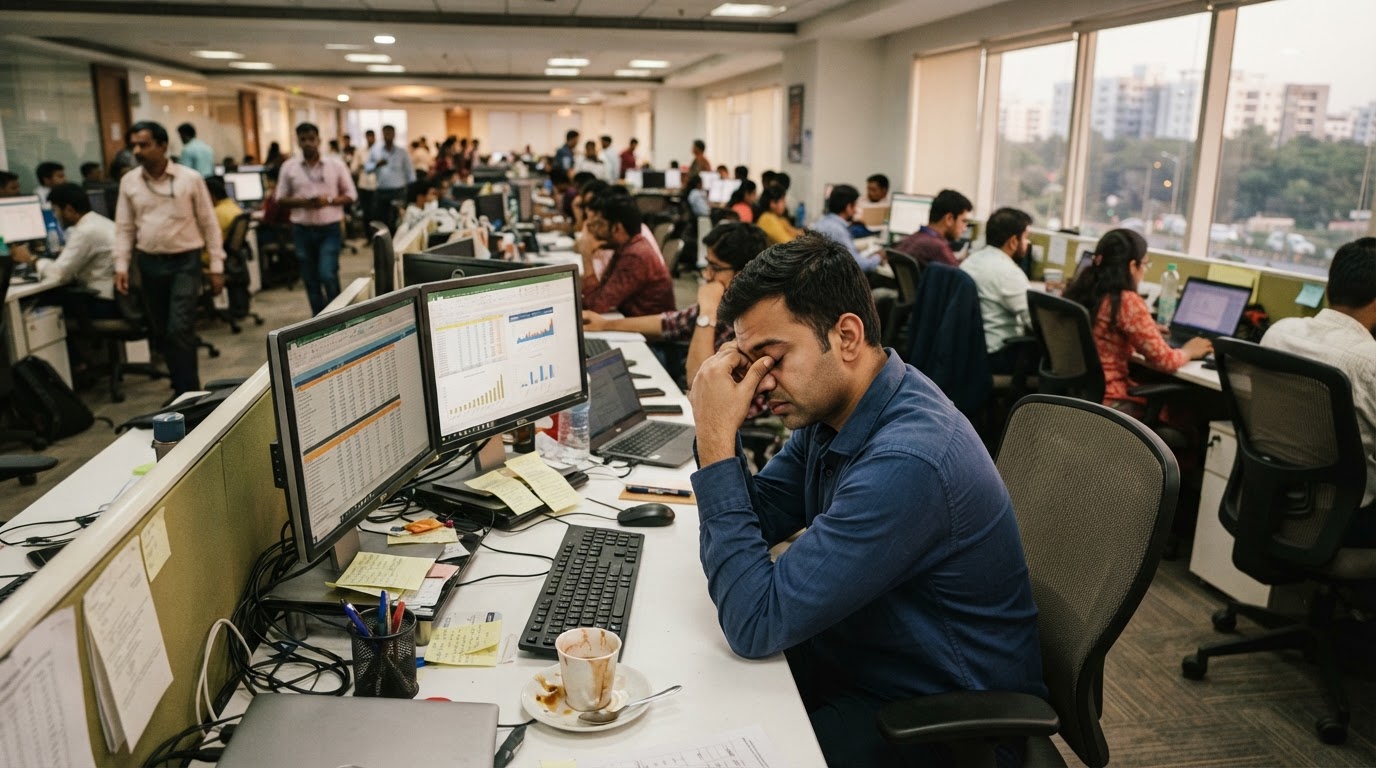
If you are an Indian salaried desk worker in your thirties or forties, this scene probably peaks right now, in the final quarter of the year. You push through the commute, lean on strong chai before stand-up meetings, survive a mid-afternoon energy drop, and wonder why your body refuses to bounce back. When we examine persistent sleep problems in office workers india, the culprit is rarely simple laziness or a lack of discipline. It is an interlocking chain of accumulated sleep debt, delayed caffeine, and circadian disruption.
Key Takeaways
- Time spent lying in bed is not identical to restorative sleep; sleep quantity, quality, timing, and biological regularity must align.
- The fourth quarter in India can intensify fatigue through post-festival routines, heavy year-end deliverables, seasonal traffic delays, and delayed dinners.
- Caffeine has an average half-life of five hours; late-afternoon tea or coffee conceals sleep debt while destroying sleep architecture.
- Catching up by sleeping in late on weekends causes social jet lag and deepens Monday exhaustion.
- A simple seven-day tracking log measuring wake time, caffeine cutoff, and morning alertness creates faster recovery than extreme sleep hacks.
Understanding Sleep Problems in Office Workers India During Q4
Many Indian desk workers find that exhaustion builds up between October and December. Between Navratri, Diwali, family gatherings, wedding season, and financial targets, your routine takes hit after hit. Many corporate employees tell themselves: Chalta hai, baad mein dekhenge. But the body keeps a very precise balance sheet.
According to the India Workforce Health Index data, 30.7% of surveyed employees reported sleeping under six hours a night (the survey’s two shortest bands), while 38.6% get only six to seven hours. Even more telling, one in four reported disturbed sleep during the preceding month. A separate 2025 survey of corporate professionals of 1,000 professionals in Chandigarh, Ludhiana, and Delhi NCR found that over 60% slept below recommended thresholds, and 64.2% were classed as poor sleepers.
During my own corporate desk years, when EPF was deducted from my payslip each month and I spent hours in traffic and office chairs, I lived that exact fatigue cycle. For nearly a decade, I ran on intense work targets, junk snacks, cigarettes, and alcohol, assuming that feeling drained by 3:00 PM was simply standard operating procedure for any working adult. I carried a belly that refused to budge, struggled with foggy mornings, and treated the symptom with more stimulation. It took stepping back years later to understand that my biological rhythm was completely out of sync with my schedule.
The Three Hidden Culprits: Sleep Debt, Late Caffeine, and Circadian Drift
To tackle sleep problems in office workers india, we have to look past generic advice like “sleep eight hours.” Most desk professionals cannot magically add two extra hours to their night without fixing three specific physiological levers.
1. Cumulative Sleep Debt
Sleep debt is the arithmetic difference between the biological sleep your system requires and what it actually receives. If your brain needs seven and a half hours of restorative rest to clear metabolic waste, but you sleep five and a half hours from Monday to Friday, you carry an accumulated deficit of roughly ten hours by the weekend. While sleeping until 11:00 AM on Sunday might take the sharp edge off your immediate drowsiness, it does not repair cognitive function, hormone balance, or cellular recovery.

2. The Caffeine Half-Life Trap
Caffeine does not give your body real energy. It simply plugs into adenosine receptors in your brain, temporarily hiding the chemical signal that tells you that you are tired. Caffeine has an average metabolic half-life of roughly five hours. That means if you drink a strong mug of filter coffee or cutting chai at 4:30 PM to survive an evening status call, roughly half of that caffeine is still circulating in your bloodstream at 9:30 PM, and a noticeable amount remains at midnight.
You might manage to fall asleep because you are completely spent, but caffeine suppresses deep slow-wave sleep. You wake up unrefreshed, reach for another morning cup, and say: Bas ek cup chai aur. The trap resets itself for another day.
3. Circadian Drift and Social Jet Lag
Your circadian rhythm is an internal 24-hour clock dictated by daylight, meal timing, physical movement, and temperature. In urban Indian centres, desk workers wake at 6:30 AM on weekdays to beat highway traffic, spend their day under artificial fluorescent tubes, return home late, eat dinner after 9:30 PM, and scroll on screens in bed. On weekends, they shift their bedtime past 1:00 AM and wake up late into the morning. This shifts their internal clock by two to three hours every single week, creating the exact biological friction of flying across time zones every Friday night.
Sleep debt cannot be outsmarted with weekend oversleeping. When your wake-up time constantly swings by three hours, your body spends every Monday morning fighting severe social jet lag.
Restoration vs. Reality: Common Sleep Assumptions
Desk workers frequently make choices they assume will help them recover, only to make their biological exhaustion worse. Let us look at what corporate reality actually looks like compared to restorative habits.
| Common Office Belief | Biological Reality | Practical Adjustment |
|---|---|---|
| “I spend eight hours in bed, so my recovery is covered.” | Tossing, shallow sleep, late digestion, and fragmented rest destroy recovery quality. | Focus on uninterrupted sleep continuity and a consistent lights-out schedule. |
| “I will make up for my weekday sleep loss on Sunday morning.” | Waking up late shifts your circadian clock, ensuring terrible sleep on Sunday night. | Keep weekend wake-up times within 60 minutes of your weekday alarm. |
| “A 4:00 PM office chai helps me finish my evening deliverables.” | Caffeine stays active for hours, reducing deep sleep stages without your awareness. | Move your final caffeine dose to before 2:00 PM or switch to water or herbal tea. |
| “Melatonin gummies are a harmless way to force sleep.” | Melatonin is a hormone, not a sedative; casual dosing disrupts natural production. | Rely on dim lighting and consistent timing before considering any supplement. |
The Evening Screen and Dinner Problem
Evening habits matter in a country where sleep problems are already common. A systematic review of Indian studies covering nearly 68,000 people estimated that 25.7% of Indians experience insomnia symptoms, while 37.4% have obstructive sleep apnea (a pooled estimate from a preprint that has not yet been peer reviewed). These are pooled estimates with wide ranges, because the studies used different methods.
The issue with checking Slack, email, or social media feeds in bed is not merely the blue light spectrum. It is psychological arousal. When you read a late-night message about project delays or upcoming quarterly targets, your sympathetic nervous system fires. Cortisol rises, core temperature increases, and your brain treats your mattress like an extension of your office workstation.
Combine that psychological stress with a heavy, oily dinner consumed at 10:00 PM. Your digestive tract is forced to process complex carbohydrates and fats while you are lying flat. This triggers acid reflux, elevates resting heart rate, and causes repeated micro-awakenings that you might not even remember the following morning.

Common Traps and Counterproductive Hacks
When professionals reach their breaking point with fatigue, they often turn to quick shortcuts that end up worsening their baseline health:
- Using alcohol to fall asleep: A nightcap might make you pass out faster by depressing your central nervous system, but it fragments REM sleep, causes dehydration, and worsens breathing interruptions.
- Sedative self-medication: Taking over-the-counter anti-allergy tablets or borrowed sleeping pills leads to tolerance, grogginess, and rebound insomnia, while ignoring underlying lifestyle causes.
- Relying entirely on wearable scores: Obsessing over your smartwatch’s daily “deep sleep percentage” causes sleep anxiety (orthosomnia). Consumer trackers are useful for observing general timing trends, but they are not clinical medical diagnostics.
- All-or-nothing lifestyle overhauls: Attempting to simultaneously quit coffee, wake up at 5:00 AM, and join a high-intensity morning bootcamp while in the middle of Q4 deliverables will only burn you out faster.
Just as building an emergency fund for Indians requires steady, unglamorous monthly allocations rather than emotional gambles, fixing your physical recovery requires boring, consistent daily rules.
A Low-Friction 7-Day Framework for Office Workers
You do not need an expensive wellness retreat to reset your baseline. If you want to address ongoing sleep problems in office workers india, run this low-friction seven-day protocol. Treat it like an objective experiment.
Step 1: Anchor Your Morning Wake Time
Pick a realistic wake-up time that comfortably allows you to get ready and commute without panic. Keep that exact wake-up time fixed for seven consecutive days, including Saturday and Sunday. Even if you went to bed late, get out of bed at the chosen time. Your wake time is the single strongest anchor for your biological clock.
Step 2: Enforce a Hard 2:00 PM Caffeine Cutoff
For the next seven days, cut out all coffee, strong tea, energy drinks, and colas after 2:00 PM. When the 4:00 PM slump hits, step outside for a brisk five-minute walk, drink cold water, or splash water on your face. Do not use chemical stimulants to mask your natural afternoon low.
Step 3: Get Natural Sunlight Within 45 Minutes of Waking
Step onto your balcony, walk on your terrace, or step outside your building for ten minutes shortly after waking. Direct morning sunlight entering the eyes shuts down natural melatonin secretion and starts your internal timer, ensuring your brain starts releasing sleep hormones sixteen hours later.
Step 4: Shift Your Dinner Window by 45 Minutes
Aim to complete dinner two to three hours before sleeping. If work demands keep you at your desk until late, make your late meal lighter—such as moong dal khichdi, clear soup, or paneer with sautéed vegetables—rather than heavy gravies, deep-fried snacks, or massive rice portions.

Step 5: Create a 45-Minute Tech Buffer
Charge your phone across the room or outside the bedroom. For the last 45 minutes before turning off the lights, disconnect from all work channels. Read a physical paperback book, do light mobility stretches, take a warm shower, or talk with your family. Give your mind room to downshift.
Your 7-Day Tracking Dashboard
Do not guess whether your habits are working. Keep a simple note on your bedside table with these four metrics every day:
| Metric | How to Track | Target Outcome |
|---|---|---|
| Sleep Window | Time lights went off vs. time out of bed | 7.5 to 8.5 hours of opportunity |
| Morning Alertness | Rate your wake-up state from 1 to 10 | Climbing above 7 by day five |
| Afternoon Slump | Record crash severity (None, Mild, Severe) | Drop from Severe to Mild without late tea |
| Caffeine Cutoff | Exact time of your last caffeinated drink | Strictly before 2:00 PM daily |
You cannot manage what you do not track. When you record your wake time, caffeine cutoff, and morning alertness for just seven days, the connection between daily habits and morning fatigue becomes unmistakable.
When Morning Fatigue Requires Medical Evaluation
While lifestyle adjustments resolve standard Q4 exhaustion, persistent fatigue can sometimes indicate an underlying clinical issue that sleep habits alone cannot fix. It is essential to understand when to consult a qualified medical professional for formal clinical testing.
Arrange a medical assessment if you notice any of these warning signs:
- Loud, chronic snoring accompanied by observed pauses in breathing, choking, or gasping during the night.
- Waking up with persistent morning headaches, extreme dry mouth, or elevated blood pressure.
- Fighting overwhelming drowsiness while driving, operating a vehicle, or sitting in routine meetings.
- Chronic inability to fall or stay asleep occurring three or more nights a week for more than three months.
- Uncomfortable crawling sensations in your legs that force you to move them when resting at night.
- Persistent exhaustion despite seven to eight hours of regular, uninterrupted sleep opportunity.
Conditions such as obstructive sleep apnea, severe vitamin deficiencies (such as D3 and B12), thyroid disorders, and clinical insomnia require precise diagnostic tests. For ongoing chronic insomnia, structured cognitive behavioural therapy for insomnia (CBT-I) conducted by qualified practitioners remains the gold-standard medical approach over long-term sleeping pills.
Frequently Asked Questions About Sleep Problems in Office Workers India
Can I adapt to functioning well on just six hours of sleep?
Sleep problems in office workers india often start with this myth. Very few adults carry the rare genetic variation required to thrive on six hours. Most people who claim they do have simply become accustomed to the sensation of chronic fatigue. If you depend on multiple alarms, require morning stimulants to think clearly, or crash on weekends, you are running an unresolved sleep deficit.
Why do I wake up exhausted even when I sleep for eight hours?
Many sleep problems in office workers india involve fragmented nights, not short ones. Sleep duration does not guarantee restorative sleep. If your night is fragmented by late-night digestion, room heat, untreated snoring or sleep apnea, late caffeine, or evening alcohol, you miss out on critical slow-wave deep sleep and REM cycles. You spent eight hours in bed, but your brain received only five hours of fragmented rest.
Is an afternoon power nap helpful or harmful for desk workers?
Naps can help with sleep problems in office workers india if they are kept short and early. A brief 15 to 20-minute nap taken between 1:00 PM and 2:30 PM can restore cognitive alertness without affecting nighttime rest. However, taking long naps exceeding 40 minutes, or napping after 4:00 PM, burns off the adenosine sleep pressure you need to fall asleep easily at night.
Will blue-light blocking glasses fix my evening screen issues?
Screens add to sleep problems in office workers india, but glasses are not the fix. Blue-light glasses only address a tiny part of the problem. They do not cancel out the mental stimulation of reading work emails, scrolling social media, or worrying about quarterly deadlines. The emotional engagement of using your phone late at night is what keeps your nervous system awake.
The Honest Takeaway on Sleep Problems in Office Workers India
Resolving widespread sleep problems in office workers india does not require extreme biohacking, expensive supplements, or rigid 5:00 AM routines that do not fit the reality of corporate life. It starts with treating your biological recovery with the same respect you give your work deliverables. Set a fixed wake time, move your last cup of chai to the early afternoon, get natural daylight on your face every morning, and keep work screens outside your bed. Your body does not demand perfection; it simply demands consistency.
If you truly read till here, I know you are serious about changing something.
Tell me in the comments: which part of this feels most relevant or confusing for your current situation, and what is one step you are taking this month?
Leave a comment below – I genuinely read them, and your question might also help someone else facing the same situation.

Abhishek Sikka writes for Indian working adults who want better health habits and safer money decisions. He shares practical lessons from his own lifestyle changes and years of market experience, with a focus on realistic routines, clear thinking, and long-term progress over extremes.
Discover more from
Subscribe to get the latest posts sent to your email.