
Table of Contents
It is a little past three. The tea beside you has gone cold, the sabudana khichdi from lunch is a distant memory, and your hand is already inside the drawer, hunting for anything crunchy. You are not weak, and you are not failing your vrat. You ate a plate that was mostly starch with very little protein, and your body is simply sending the bill.
I am writing this with respect for the fast, not against it. I have lived desk and corporate life myself, belly and messy food included, so I know how easily ‘vrat food’ gets treated as automatically light. This post is a practical navratri fasting diet for office workers: keep the fast, keep your blood sugar steadier, skip the deep-fried traps. Sharad Navratri this year runs from 11 to 19 October, with Dussehra on 20 October. If you started on Sunday, you are only a few days in, and there is plenty of time to adjust.
Key Takeaways
- The usual vrat plate (sabudana, aloo, fried puri) is heavy on fast-digesting starch and light on protein, which is why the 3 pm slump and cravings show up.
- Swapping a fried puri for a roasted roti mainly cuts fat and calories. Carbs barely move, so portion size and added protein matter more.
- In any navratri fasting diet for office workers, anchor every meal with curd, paneer, milk, buttermilk, peanuts or makhana, and move the tea-and-snack cycle onto those.
- Diabetics, pre-diabetics, people on BP or diabetes tablets and anyone with acidity should talk to their doctor before a strict fast. Never stop medicines on your own.
- Buy kuttu flour only from a trusted, labelled seller in small quantities. Plan Dussehra and Diwali sweets by the piece, or one evening can undo nine days.
The vrat trap in a navratri fasting diet for office workers: why the 3 pm crash keeps showing up
Fasting menus are built around starch: sabudana, potato, kuttu, singhara, samak. Protein only enters if you deliberately add it. For a desk worker with a long day, that leaves a lot of tea, a lot of starch and very little to hold your hunger steady.
Take sabudana, the most common office-vrat breakfast. It is processed starch from cassava root, not a grain. Dry sabudana comes to roughly 358 kcal, 88.7 g of carbohydrate and about 0.2 g of protein per 100 g. One estimate puts a standard 200 g khichdi serving at around 76 g of fast-digesting carbohydrate.
The glycaemic index figures online are inconsistent, roughly 65 to 85 depending on the source (see this explainer), and none come from a proper food database. So I will only say it is reported as high-GI and low in protein relative to its carbs. Peanuts in the khichdi help a little, but not enough to change the picture.
The pattern is plausible: a quick glucose rise from refined starch, then hunger a few hours later. I would call it a common pattern, not a diagnosis. The afternoon dip also overlaps with sugary tea, poor sleep and the natural post-lunch lull. If what you feel is more than a slump (shakiness, sweating, confusion), skip to the section on who should not do a strict fast.
Then comes the fried layer: kuttu or singhara puris, pakoras, aloo tikki. They add oil and refined starch together. Most of us know this and still say it out loud anyway: Vrat hai, thoda sa chalega. One plate, fine. Nine days of it, plus four sugary teas, is a different matter.
Why this matters beyond one afternoon
If you are a salaried man in your thirties or forties with a belly, your blood sugar is not a side issue. The national ICMR-INDIAB study found diabetes prevalence of 11.4%, prediabetes of 15.3% and abdominal obesity of 39.5%.
That translates to about 101 million people with diabetes and 136 million with prediabetes. The survey ran from 2008 to 2020 and the headline counts are national estimates for 2021, so the picture today is unlikely to be better. The authors treat that large prediabetes pool as a window for prevention, and that is how I read it too: most of these people do not know yet.
My own context is small. In my corporate desk years I carried a belly, with poor sleep, high stress and messy food, and regular workouts are what changed that. These days my evening snack is roasted makhana and chana rather than biscuits, and I experiment with 18-hour fasts, so I am not against fasting as such. I am also not a nutrition expert. I am a peer who has seen how the desk-job plate goes wrong, and I am sharing what the numbers say.
Fried puri plate vs roasted plate: what the numbers say
The online figures vary a lot, and most come from recipe and app sites rather than the national food-composition tables. Treat everything below as rough. Recipe sites list kuttu puris at suspiciously low calories that do not agree with each other, so I have used wheat-puri data as a proxy for a fried puri.
According to this calorie breakdown, a medium puri has about 14 g of carbs, 6 g of fat and 1.8 g of protein, and frying adds roughly 50 to 60 kcal of oil per piece. Four puris with aloo bhaji come to roughly 550 to 680 kcal with about 9 g of protein. By contrast, a 40 g kuttu roti is listed at about 108.6 kcal, 21.3 g of carbs, 3.8 g of protein and 3 g of fibre.
| Plate | Rough calories | Rough protein | What it tells you |
|---|---|---|---|
| 4 fried puris + aloo bhaji | About 550-680 kcal | About 9 g | Oil and refined starch, little to keep you full |
| 2 tawa-roasted kuttu rotis + paneer-lauki sabzi + a bowl of curd (my estimate) | About 450-550 kcal | Roughly 2-3 times more | Less oil, protein built in |
Here is the honest part. Swapping fried for roasted cuts fat and about 50 to 60 kcal per piece, but a kuttu roti has about as many carbs as a puri. It is better than fried, not ‘diabetic-safe’. The real levers for your afternoon glucose are portion size, protein and fibre on the plate, and dropping the extra aloo.
The problem is rarely the fast. It is fried starch with no protein, repeated nine times over.
A navratri fasting diet for office workers: a realistic 9-to-7 day
Fasting practices differ. Some people eat one meal, some eat permitted foods all day, some avoid dairy. I am assuming milk products, peanuts and makhana are allowed in your vrat. If not, adjust within your own rules. The principle behind a good navratri fasting diet for office workers is simple: keep the fast, anchor each eating slot with protein, and cut the fry. A calorie deficit is a bonus, not the goal.
| Slot | What tends to work | Why |
|---|---|---|
| Before you leave home | Curd or a glass of milk with a handful of roasted peanuts or makhana, or a tawa-cooked kuttu or singhara cheela with paneer filling | Protein goes in before the tea cycle starts |
| Mid-morning | Buttermilk and a fruit such as apple, guava or papaya | Replaces the sugary mid-morning tea |
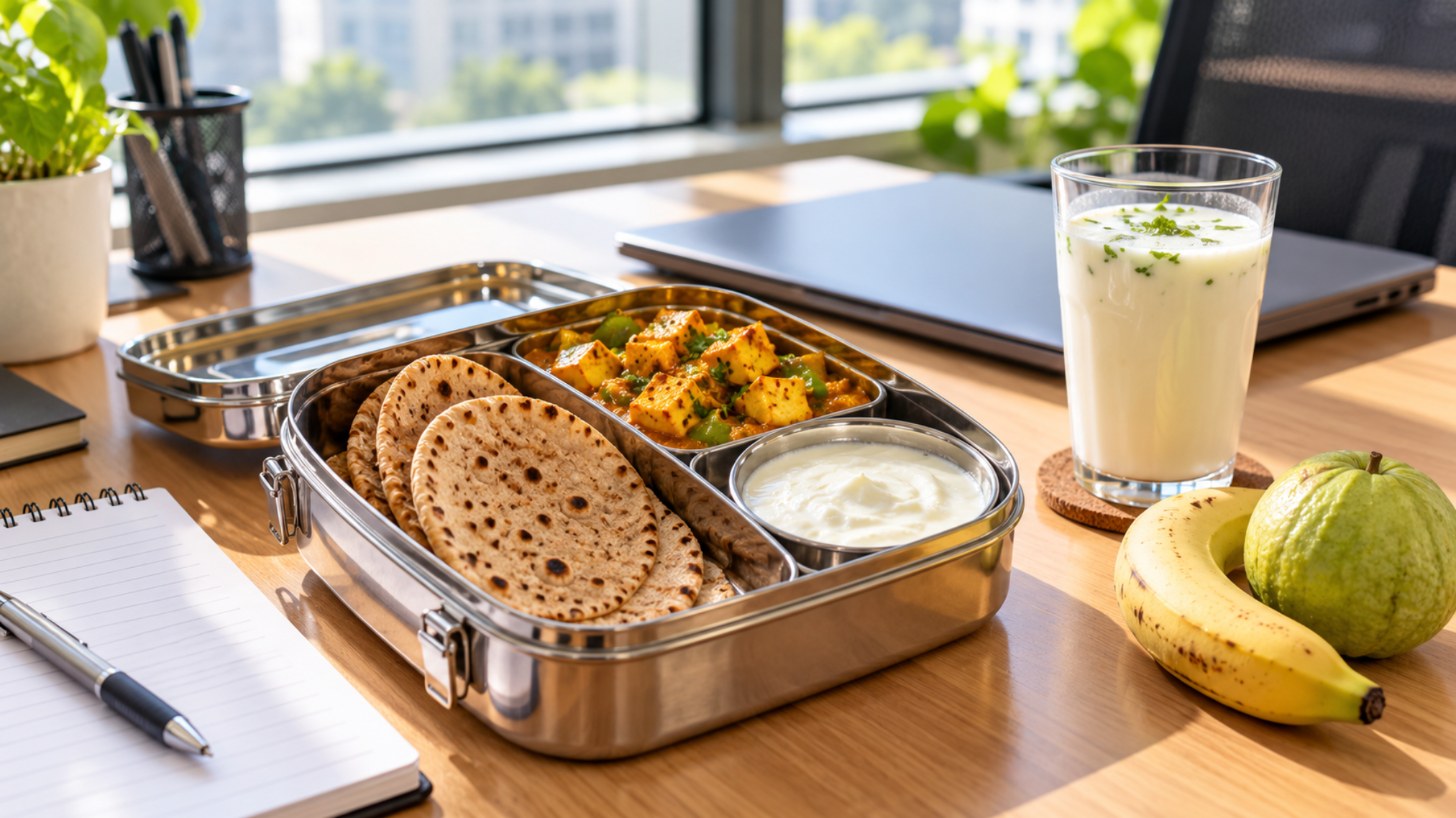
| Lunch (your biggest meal) | 2 tawa-roasted kuttu or rajgira rotis, lauki or pumpkin sabzi, paneer or curd. Or a small bowl of samak rice with curd and vegetables | The largest meal sits before the afternoon dip |
| Late afternoon (the 3 pm slot) | Tea with little or no sugar, plus about 30 g roasted makhana or peanuts. A glass of milk also works | A protein-and-fat snack is ready, so the fried packet loses its pull |
| Evening | Paneer bhurji or curd with a sabzi and one roti. If you want sabudana, about half a katori with peanuts and vegetables | No late puri plate, no big evening spike after a long gap |
| Through the day | Water, and a short walk after meals if you can manage it | Helps you stay on top of fluids and keeps you moving |
My rough arithmetic for a day like this is about 45 to 50 g of protein: milk, paneer, curd, peanuts, makhana and the kuttu rotis together. Treat that as an estimate, not a lab figure. Compare it with your own protein target rather than copying mine.
A few smaller traps worth naming. Four sugary teas plus packaged vrat snacks is the classic loop, and it is the loop you are trying to break at 3 pm. Long gaps with only tea followed by a heavy evening meal can leave you flat all day and stuffed at night. Fruit juice, date-and-jaggery laddus and ‘healthy’ sweetened shakes are sugar loads with no fibre. Sendha namak is still sodium, which matters if you have BP concerns. And if you are prone to acidity, avoid tea on an empty stomach.
Who should not follow a strict navratri fasting diet for office workers, and when to talk to a doctor
This is not about religious practice. It is about the body in front of you. A review of the Navratri fast in an Indian endocrinology journal noted that many people with diabetes fast regardless of the health implications, often without proper education or medical advice. Please do not be that statistic.
- Diabetes or prediabetes: talk to your doctor before fasting, especially if you take insulin or medicines that can lower blood sugar. This 2026 explainer says the same, and adds that kuttu and singhara rotis still contain carbohydrates, so portions matter.
- On BP or diabetes tablets: never stop or change your medicines on your own. If you want to keep the fast, ask your doctor how to adjust the schedule. Dehydration is also a concern with some BP medicines.
- Acidity or reflux: long gaps and fried or sour food tend to make it worse. A partial fast is a perfectly respectable option.
- Others who should check first: pregnant or breastfeeding women, people with kidney problems and anyone with a history of eating disorders.
Stop and break the fast if you feel dizzy, sweaty, shaky, confused or unusually weak. A clinic guide on fasting with diabetes lists what a doctor may consider before advising someone, including HbA1c, glucose patterns, medicines, kidney function and any history of low sugar. Partial fasts and alternative observances exist for a reason. Devotion does not need you to ignore a warning sign.
The kuttu flour safety note
This one is not theoretical. In September 2025, over 200 people in Delhi fell ill after eating food made from buckwheat (kuttu) flour during the fast. Reports pointed to suspected contamination, and I could not find a published finding on the exact cause, so I will not guess. The incident summary notes no deaths.
It is also not a one-off. Earlier reports include over 500 people ill in Delhi in 2021, over 300 in Sonepat and over 120 in Bijnor. In 2024, FSSAI wrote that most festival-season food poisoning incidents, especially during Navratri, were linked to kuttu atta, and that the likely cause was the sale of old stock, meaning stale flour infested with fungus. This year FSSAI’s circular ahead of Navratri and Diwali lets authorities sample fasting flours like kuttu and singhada atta, and Haryana’s food authority has warned that damp, stale or fungus-contaminated flour can cause food poisoning.
What tends to help:
- Buy from a licensed or branded seller, and avoid loose flour from unlabelled bags.
- Check the packing date and best-before date, and buy small quantities so you always use fresh stock.
- Throw away flour that smells musty or sour, even if you paid for it.
- If vomiting, diarrhoea, stomach pain or fever follow a kuttu meal, seek medical care promptly.
Another reason to keep roasted rotis and a few options in rotation is that you are not depending on one flour for nine days.
Breaking the fast after a navratri fasting diet for office workers: Dussehra and Diwali without undoing the nine days
Local panchang timings vary, and Ashtami and Navami fall together on 19 October in Delhi’s calendar, while some calendars show Ashtami on 18 October. So you may be breaking your fast on 19 or 20 October. Either way, the first meal matters more than the sweets that follow. Start with curd, fruit or a small plate of normal food, not a heavy fried meal.
Diwali is a separate window. Dhanteras is on 6 November, Lakshmi Puja on 8 November and Bhai Dooj on 10 November, about 19 days after Dussehra. That means two sweets budgets, not one. Per-piece calorie figures vary by size and source, so this is arithmetic, not precision. For example, a small gulab jamun is about 97 kcal and a medium one about 129, and popular desi sweets such as laddus and Mysore pak run well above that. A kaju katli is around 120 kcal with 15.5 g of carbs, and most people eat three to five.
| Sweets scenario (my estimates) | Rough calories | What it means |
|---|---|---|
| 1-2 pieces a day, after a protein-containing meal | About 150-350 kcal | A treat that fits into the day |
| 5 pieces in one evening | About 600-900 kcal | Roughly a full extra meal |
| A gift box of 12 pieces at about 150 kcal each | About 1,800 kcal | Decide the share before the box arrives |
So a simple rule: treat one piece of mithai as about 120 to 200 kcal, set a ceiling of one or two a day, and eat them after a meal, not on an empty stomach. Pick one favourite and treat the rest as optional. Bas ek aur laddu is how the maths quietly breaks. The days without a festival gathering are where you return to protein-anchored meals and no fried snacks.
A nine-day calorie dip can be erased in a single festival evening. The days after the fast decide more than the fast itself.
Carry the lighter pattern forward, and get a glucose check
If I could keep one thing from this navratri fasting diet for office workers, it would not be the fasting. It would be the plate: protein at each meal, tea with less sugar, roasted instead of fried. That pattern works on a non-vrat Tuesday too, and it is a far better habit than a ‘nine-day cleanse’. I found no good evidence for detox framing, so I would skip it.
Next, a number. A nine-day fast will not show up cleanly in an HbA1c test, which reflects roughly the last three months. A fasting glucose and HbA1c check now gives you a baseline, and a repeat after Diwali gives a more meaningful picture. Many men with a belly and a family history never test until a symptom forces it.
Your lab report prints its own reference ranges, and your doctor can tell you how to read them, particularly if you have anaemia, which can distort HbA1c. I will go deeper on reading lab reports in a later post. Your waist measured at the navel is a useful companion number.
Frequently Asked Questions
Can a navratri fasting diet for office workers help me lose belly fat?
Some people lose a little weight from lower intake. Visceral fat changes with sustained habits, and I did not find solid evidence for a 9-day fast specifically. The real risk is the rebound after Dussehra and Diwali, which is why the sweets budget matters.
Is kuttu better than sabudana in a Navratri fast?
Generally yes: kuttu roti has a few grams of protein and fibre per piece, while sabudana has almost none. But kuttu still has carbs, and in puri form it picks up oil. Better than fried, not safe for everyone.
Can I keep taking my BP or diabetes tablets during the fast?
Do not stop or skip them on your own. Ask your doctor whether the timing or dose needs adjusting for the fast, and have that conversation before you start the next fast day, not after a dizzy spell.
Is it safe to buy kuttu atta this week?
Only from a reliable, labelled seller, in small quantities, with a fresh packing date. Discard anything that smells musty or sour.
The honest takeaway
You do not have to choose between your faith and your blood sugar. A good navratri fasting diet for office workers is the same fast, with a little protein at every stop, less oil and less sugar in the tea. Check with your doctor first if you have diabetes, BP or acidity, buy your flour carefully, and plan your sweets by the piece. Then use the next three months to see what your glucose and your waist really say.
If you truly read till here, I know you are serious about changing something.
Tell me in the comments: which part of this feels most relevant or confusing for your current situation, and what is one step you are taking this month?
Leave a comment below – I genuinely read them, and your question might also help someone else facing the same situation.

Abhishek Sikka writes for Indian working adults who want better health habits and safer money decisions. He shares practical lessons from his own lifestyle changes and years of market experience, with a focus on realistic routines, clear thinking, and long-term progress over extremes.
Discover more from
Subscribe to get the latest posts sent to your email.