
It was a typical expiry day for Nifty. I had been sitting at my trading desk since before the market even opened, eyes locked on the screen through every swing. By early afternoon my back was stiff, my mind frayed from the emotional rollercoaster of the day’s moves, and a heavy post-lunch sluggishness had settled over my brain.
Like many of you, I had been glued to my chair since before market open, driven by the pressure of protecting capital, managing risk on every trade, and the quiet toll of watching every tick until the closing bell. That day is what finally got me to look seriously at the 45-minute sitting rule that health experts now recommend, and at a search query I see from fellow traders and professionals alike: how long is it safe to sit at a desk indian office workers? We know that our sedentary lifestyle is harming us, but between tracking positions, reacting to every move, and staying glued to the charts, finding time for health feels impossible.
This week, the health data coming out of corporate India has been nothing short of a wake-up call. We are facing a silent epidemic that targets our exact demographic—salaried professionals in their late 20s to early 40s. The good news? You do not need to quit your job or spend two hours in the gym every day to protect yourself. The solution lies in a simple, highly effective habit: the 45-minute sitting rule.
Table of Contents
Key Takeaways
- Working Indians are facing a major health crisis, with new 2026 data showing 8 in 10 are overweight and nearly half have prediabetes or diabetes.
- Continuous sitting reduces insulin sensitivity and causes blood sugar spikes, especially after meals.
- The 45-minute rule: Never sit continuously for more than 45 minutes; take a 2-3 minute walking or standing break.
- Micro-breaks are a separate health lever from your daily gym workout—you need both to combat sedentary risks.
- Simple office and WFH hacks, like standing during audio calls or taking the stairs, can easily add 30 minutes of movement to your day without hurting productivity.
The Silent Crisis: What The 2026 Data Actually Says
If you think lifestyle diseases only happen to retired folks, the latest corporate health-check data will shock you. According to the Apollo Health of the Nation 2026 report, which analysed over 3 million health checks, 8 in 10 working Indians are overweight. What is even more alarming is that nearly half of working adults already have prediabetes or diabetes.
Keep in mind, the average age of the people in this data pool is just around 38 years. These are our colleagues, our managers, and ourselves. We are sitting in air-conditioned offices, building the nation’s IT infrastructure and financial systems, while our internal health silently collapses. Just last month, the BRICS New Delhi Declaration officially recognised obesity and non-communicable diseases as major global public health challenges. Health experts commenting on the summit explicitly warned that prolonged inactivity, coupled with excess calorie intake, significantly contributes to weight gain and accelerates the onset of type 2 diabetes among desk workers.
We often stress about building a robust emergency fund for Indians to protect against financial shocks, but we completely ignore the medical shocks that our daily sitting habits are guaranteeing.

The Golden Question: how long is it safe to sit at a desk indian office workers?
Let us address the core question: how long is it safe to sit at a desk indian office workers? While there is no single law governing this, cardiologists and endocrinologists have reached a strong consensus based on human physiology. For Indian desk workers, especially those in their 30s and 40s with a family history of diabetes, the practical rule is: do not sit continuously for more than 30 to 45 minutes at a stretch.
Why is this specific timeframe so critical? When you sit still for an hour or more, the muscle activity in your legs and trunk drops to near zero. Your blood flow slows down, pooling in your lower body. More importantly, your body’s insulin sensitivity decreases. If you have just eaten a heavy Indian lunch—perhaps rice, dal, and sabzi—and you immediately sit at your desk for three hours, your blood sugar spikes and stays elevated because your muscles are not moving to absorb that glucose.
A recent 2024-2025 medical review on sedentary behaviour confirmed that breaking up sedentary time at least every 30 minutes significantly improves glucose control. You do not need to run a marathon; just 2 to 3 minutes of standing, stretching, or slow walking is enough to reactivate those large muscle groups and prompt your body to process blood sugar efficiently.
“You cannot out-train 10 hours of continuous sitting with a 45-minute gym session. Micro-breaks are not a replacement for exercise; they are a mandatory baseline for metabolic survival.”
The Biggest Trap: “But I Go To The Gym!”
One of the most dangerous myths I hear from my peers is the idea of compensation. Many of us believe that if we hit the gym for an hour in the morning, we have earned the right to sit completely motionless for the next 12 hours. Science strongly disagrees. Prolonged, uninterrupted sitting carries independent risks for cardiovascular health, regardless of your evening workout routine.
Furthermore, let us be honest about our actual habits. The corporate health data reveals that two-thirds of working Indians don’t even reach basic activity guidelines. For the vast majority of us, managing our sitting patterns during the 9-to-6 window is the most realistic and immediate health lever we have.
| The Sedentary Gym-Goer | The 45-Minute Breaker |
|---|---|
| Sits continuously for 4-5 hours at a stretch. | Interrupts sitting every 45 minutes for 2-3 mins. |
| Experiences massive post-lunch energy crashes. | Maintains stable energy levels throughout the day. |
| High risk of blood sugar spikes after meals. | Better glucose uptake due to frequent muscle activation. |
| Relies solely on a 45-min workout to offset 12 hours of sitting. | Accumulates 30+ minutes of light movement during work hours naturally. |

A Realistic 9-to-6 Template For Indian Offices
Theory is great, but how do we actually implement this when our calendars are blocked with endless Microsoft Teams meetings and urgent deliverables? Just as we automate our wealth-building through how to start a SIP in India, we need to automate our movement habits. Here is a realistic template you can adapt for your workday.
9:00 AM – 9:45 AM: The Morning Focus
Sit and clear your urgent emails or deep-focus tasks. At 9:45 AM, take your first micro-break. Stand up, walk to the pantry to fill your water bottle, and stretch your calves. This takes exactly 3 minutes.
9:48 AM – 10:33 AM: The Collaboration Block
Back to your desk for calls or coding. At 10:33 AM, take the stairs down one flight and walk back up. Do a quick shoulder roll.
11:20 AM: The Audio Call Hack
If you have an audio-only call, do not sit. Put on your earphones and pace slowly near your desk or in the corridor. You are still working, but your leg muscles are actively burning glucose.
12:15 PM – 1:00 PM: The Lunch Strategy
This is the most critical part of your day. After eating your lunch, do not immediately return to your chair. Spend 10 to 15 minutes walking around the office campus or the building compound. This blunts the post-meal blood sugar spike dramatically.
2:30 PM: The Afternoon Slump Buster
Instead of messaging a colleague on Slack who sits 50 feet away, walk over to their desk to ask your question. It builds better workplace relationships and saves you from continuous sitting.
By following this simple rhythm, you accumulate 10 to 12 micro-breaks across the day. That equals 20 to 30 minutes of light movement, plus a 15-minute post-lunch walk. You have just added 45 minutes of health-protecting activity to your day without breaking a sweat or compromising your output.

Navigating Office Culture & WFH Realities
I know what you are thinking: “My boss will think I am slacking off if I keep walking around.” In traditional Indian work cultures, sitting at a desk is often falsely equated with productivity. The key is to keep your movement subtle and tied to natural task boundaries.
You do not need to announce your health breaks. Frame them around natural office rhythms: fetching printouts, refilling water, or using the washroom. If challenged, frame it around productivity. A simple, “I find that a quick 2-minute stretch keeps my focus sharp and prevents headaches,” usually satisfies even the strictest managers.
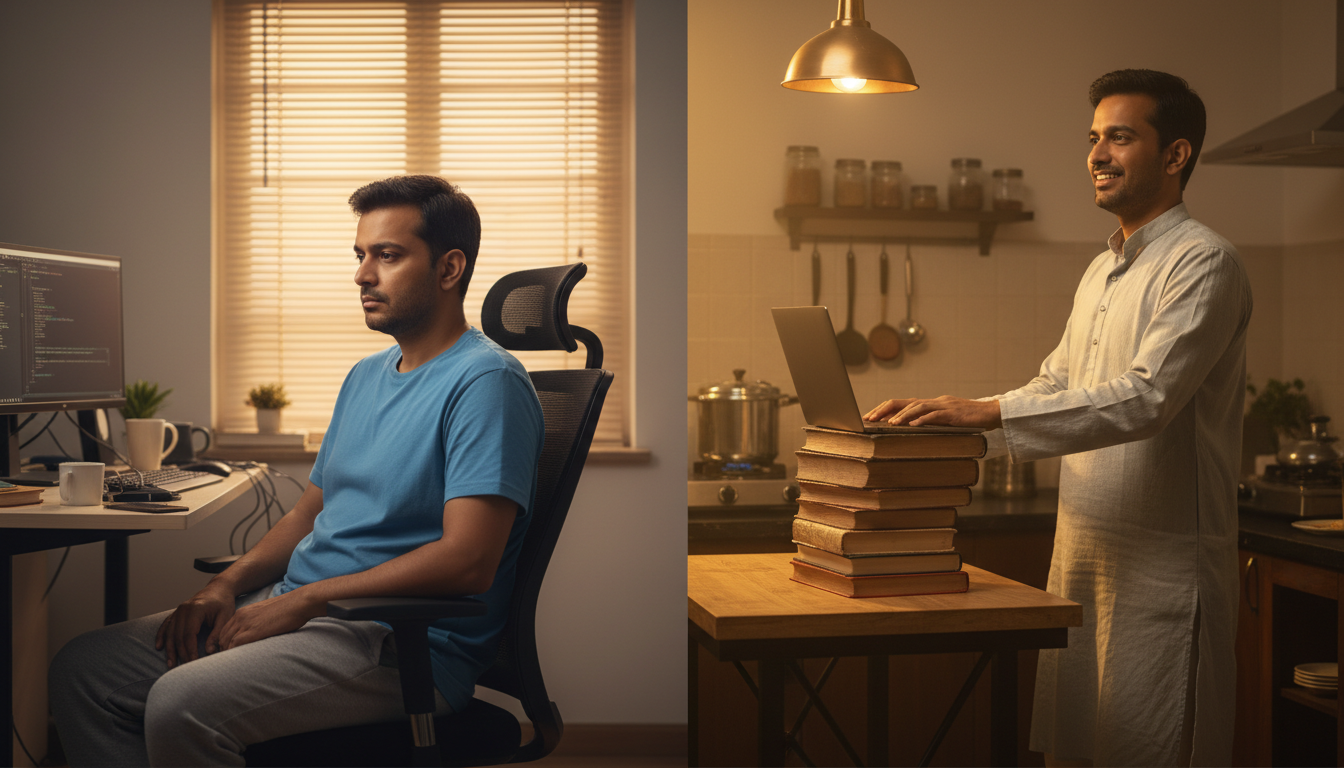
For those of us in Work From Home (WFH) or hybrid setups, the danger is actually higher. Without the need to commute or walk to meeting rooms, WFH professionals often sit for 3 to 4 hours straight. My favourite low-cost WFH hack is the kitchen counter standing desk. Place your laptop on a sturdy shelf or counter for 30 minutes while you clear emails. Alternatively, tie your 45-minute breaks to household chores: fold laundry for two minutes, water the plants, or put away dishes. It keeps your home clean and your blood sugar stable.
Self-Check: Are Your Sitting Patterns Dangerous?
Before you close this tab, do a quick self-audit. Your body gives you clear signals when your sitting habits are pushing you toward metabolic trouble.
First, check your waist circumference. Even if your overall weight seems fine, abdominal obesity is a massive risk factor for Indians. If your waist is above 90 cm (for men) or 80 cm (for women), and you sit for long uninterrupted periods, your diabetes risk is severely elevated. Second, monitor your post-lunch energy. If you experience heavy brain fog and an overwhelming urge to sleep every afternoon at your desk, it is a strong indicator of a blood-sugar spike followed by a crash. Your current pattern of a heavy meal followed by continuous sitting is not working.
“Think of these micro-breaks as an insurance policy. You wouldn’t skip paying your term plan premium; don’t skip your 45-minute movement premium either.”

Frequently Asked Questions
Q1: Realistically, how long is it safe to sit at a desk indian office workers?
For most relatively healthy adults, you should aim to keep continuous sitting to 30 to 45 minutes at a stretch. After this, you must stand or walk for 2 to 3 minutes. If you are overweight, have a family history of diabetes, or are already prediabetic, you should lean closer to the 30-minute mark to better manage your insulin sensitivity.
Q2: If I break up my sitting every 45 minutes but still do not exercise, is it enough?
It is not a complete replacement for formal cardiovascular or strength training. However, breaking up your sitting is a powerful baseline defence. It specifically targets blood sugar control and blood pressure during the day. Given that a majority of working professionals get zero exercise, adopting the 45-minute rule is a massive step in the right direction.
Q3: I already walk 10,000 steps a day. Do I still need to worry about sitting?
Yes. Step count is fantastic, but timing matters. If you get all 10,000 steps during a morning walk, but then sit entirely motionless from 9 AM to 6 PM, your body still experiences the negative metabolic effects of prolonged sedentary behaviour during those 9 hours. You need both: a good daily step count AND frequent interruptions to your sitting time.
Q4: What if my job requires deep coding and I cannot break my focus?
Use natural chunking. Complete one logical unit of work—a specific function, a module, or a report section—and then stand up. You can also try standing up but staying at your desk while you think through a complex problem. The goal is muscle activation, not necessarily leaving your workspace.
Final Thoughts
We are living in an era where our professional success is actively competing with our physical health. The data from 2026 is terrifying, but it is not a life sentence. You have the power to change your trajectory starting tomorrow morning. Set a vibrating alarm on your phone or smartwatch for every 45 minutes. When it buzzes, stand up. It is that simple. If someone asks you how long is it safe to sit at a desk indian office workers, tell them the truth: anything past 45 minutes is a compromise on your future. Let us commit to moving a little more, sitting a little less, and reclaiming our health one micro-break at a time.
If you truly read till here, I know you are serious about changing something.
Tell me in the comments: which part of this feels most relevant or confusing for your current situation, and what is one step you are taking this month?
Leave a comment below – I genuinely read them, and your question might also help someone else facing the same situation.

Abhishek Sikka writes for Indian working adults who want better health habits and safer money decisions. He shares practical lessons from his own lifestyle changes and years of market experience, with a focus on realistic routines, clear thinking, and long-term progress over extremes.
Discover more from
Subscribe to get the latest posts sent to your email.