
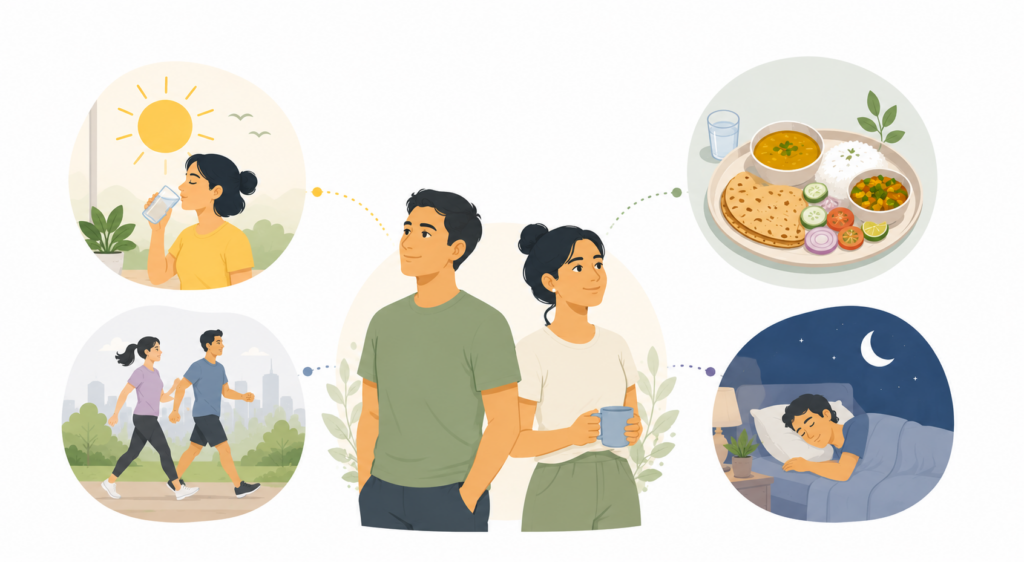
This blog is not about perfect diet charts or 5 a.m. miracle routines. It’s about 4 daily habits for a healthy life—morning routine, food, movement, and sleep—that helped me slowly come out of a loop.
For almost a decade, I lived on stress, cigarettes, junk food, and alcohol. I thought I was just “managing life”. But in reality, I was quietly destroying my health, my sleep, and my mind, and then i rebuilt my life through small changes in daily habits. If your life also feels like a repeat telecast of the same tired day, this is for you.
Table of Contents
Habits: the invisible script of our day
Habits are the things we do on autopilot, without much effort or thinking. Brushing teeth, taking the same route to office, pouring chai into a glass, climbing stairs at home or work—these are actions we’ve repeated so many times that the brain has turned them into a default script.
Practicaly anything we repeat regularly becomes a habit, like a very comon habit of checking our phone even when it is not required. I won’t spend time defining what are “good” and “bad” habits; as adults, most of us already know what is good or bad for us. All we have to do is aks:
“Jo main kar raha hoon, kya ye mere liye sahi hai ya galat?”
Usually, we already know the answer. The hard part is that we rarely ask this question at all.
From childhood, most of us were trained to answer, not to question. Asking questions was sometimes treated like a weakness— “isko itna bhi nahin pata?” Before giving you any list of habits I follow and recommend, I want you to build one meta‑habit first: the habit of asking yourself questions.
Take few minutes out of your busy routine,sit with yourself and imagine almost like you are stepping out of your own body and looking at yourself from the outside. Then gently ask:

For me, the first honest answers to these questions were very uncomfortable. But that discomfort was the starting point of real change.
A day in the life of bad habits
Let me tell you a short story of a man full of bad habits.
It’s 8 a.m. The alarm has been snoozed three or four times already. Finally, he drags himself out of bed. Before even sitting up properly, his hand reaches into the drawer for a cigarette. After 10 minutes, he suddenly realises he is late—he has to reach office by 9:30 a.m.
Now the race begins.
In 30 minutes, he somehow manages everything: bathroom, bath, clothes, random breakfast that he doesn’t even remember eating. His body is already flooded with stress and his brain is chasing the clock. The whole day he is just reacting—emails, calls, tasks—waiting for the clock to finally hit 6 p.m. so he can shut the laptop.
On the way home, he is craving roadside junk food. All‑day stress and poor sleep have trained his brain to look for quick pleasure. Later at night, alcohol feels like the “only way” to switch off. He thinks it is helping him sleep, but in reality, alcohol is only making him numb; the sleep quality is poor, and the next morning the same loop starts again.
That man was me, about ten years ago.
At that time, those habits felt normal. They were so strong that I didn’t even see them as habits; I saw them as “this is just how life is.” I honestly believed I was doing fine.
Things changed the day I truly looked at myself from outside and started asking hard questions. Changing those habits took years, not days. Just like it took months and years for the bad habits to form, it took consistent, slow effort to erase them and build better ones. What finally worked was not a 7‑day challenge or a 30‑day transformation. Only long‑term goals and small, repeatable systems worked for me.
Financial health and physical health often improve through the same principle: small habits repeated consistently over long periods. I wrote more about that in my article on rebuilding health habits.
Why short‑term plans fail us
Most short‑term health plans fail because they depend on temporary motivation instead of everyday systems. Motivation is like a New Year’s resolution—very high for a few days, then it slowly disappears.
You’ve seen this pattern:
- Joining the gym in January, stopping by February.
- Trying a zero‑carb diet and giving up after a week.
- Forcing yourself to wake up at 5 a.m. when your work and family life are not designed for it.
- Starting with extreme workouts or 10 km runs on Day 1 after years of inactivity.
- Doing a “digital detox” for two days and then scrolling even more to “catch up”.
These extreme changes feel powerful in the moment, but they don’t match your real life. So, when life pushes back—office, kids, travel, stress—the system breaks and you feel like you are the failure, when actually the plan was unrealistic.
A more honest approach is:
- Start from your current reality.
- Improve 5–10% at a time.
- Use the power of compounding: small changes done daily become big changes over months and years.
If you want to lose weight, for example, instead of suddenly going zero‑carb, you can start with just one clean meal a day—more protein and fibre, fewer refined carbs and deep‑fried items. Once that becomes natural, you adjust the next meal.
Creating a healthy lifestyle through daily habits works best when it respects your body’s biology and your actual schedule. Big breakthroughs are rare; what really changes your life is repeatable systems that fit your reality.
As you read the four habits below, ask yourself honestly: “Which one of these fits my current life the most? Where can I start with just a 5–10% improvement?”
1. Morning habits: that can make your whole day healthier
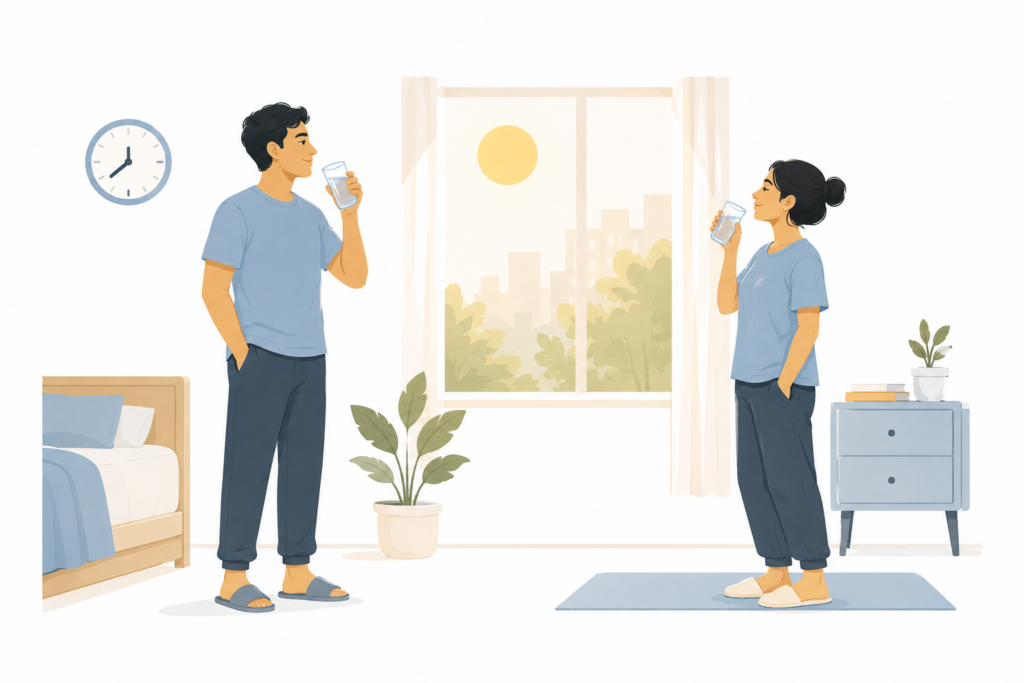
Morning is critical. The first 60–90 minutes after waking send a strong signal to your body and brain about what kind of day this will be.
Sunlight and gentle movement
As soon as you leave the bed, look for light—ideally natural sunlight. Viewing morning light for about 10–30 minutes within one to two hours of waking helps reset your body clock, improves daytime alertness, and can support better sleep at night. If you can combine this with a simple walk, even around your building, you get an added boost for mood and stress.
Hydration that suits Indian life
Start your day with a glass of water before chai or coffee. Most adults do well with around 2–3.5 litres of total fluids per day, more in hot weather or if you sweat a lot. In Indian summers, a traditional nimbu pani with a pinch of salt, or nariyal pani, can help replace fluids and electrolytes—especially if you’ve been sweating. Just be mindful of added sugar and, if you have blood pressure issues, of too much salt.
Gratitude towards yourself
Sit quietly (or even look in the mirror) for 5–10 minutes and mentally thank yourself for the things you’ve handled so far in life—responsibilities, challenges, small wins. Practising gratitude has been linked with better mood, less stress, and sometimes better sleep. For me, this simple act honestly builds confidence and reminds me that I’m not starting from zero.
Emotional connection before work mode
Before you rush into work mode, take a moment to connect with someone you care about—a smile, a hug, a message to your kids, spouse, parents, sibling, or friend. Feeling connected and supported is a powerful buffer against stress and loneliness.
Quick reflection: if you changed only the first 30 minutes after you wake up, what is the one small thing from above you feel truly willing to try tomorrow morning?
2. Nutrition and sustainable eating (Indian style, not Western diet charts)
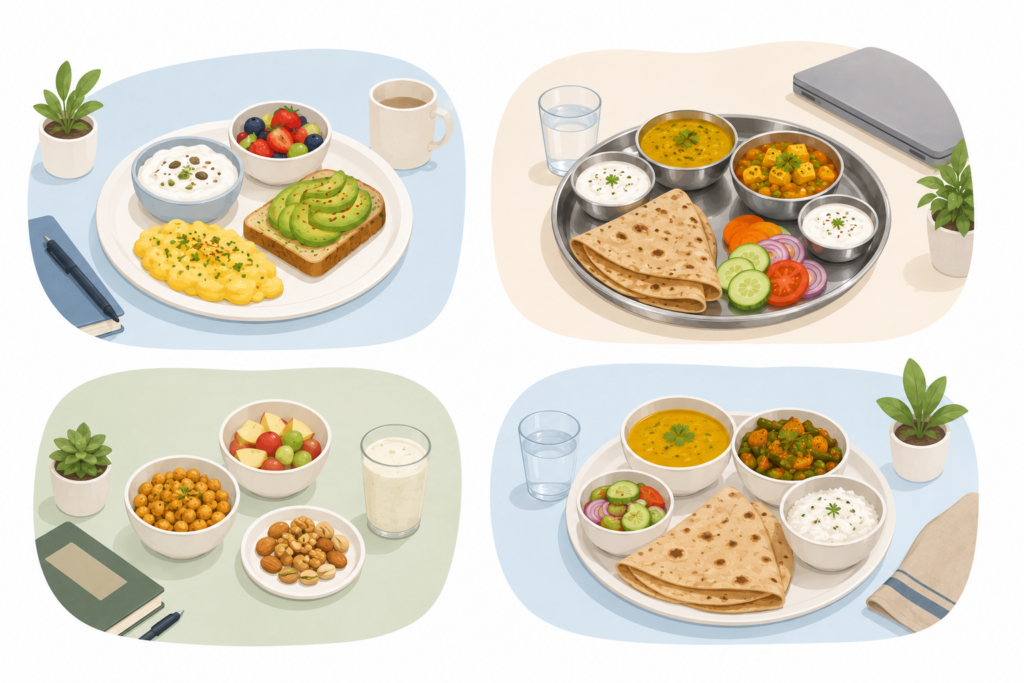
Food is not just fuel; it’s culture, comfort, and family. That’s why extreme diets usually fail. Instead of fighting Indian food, work with it.
Breakfast: start with food, not punishment
Especially in the beginning of your lifestyle change, don’t start with crash diets or aggressive fasting. Research shows that breakfasts with good protein help keep you full longer, reduce cravings, and may improve concentration compared with low‑protein or no breakfast.
In the Indian context, this can be as simple as adding curd, paneer, eggs, sprouts, or dal to your usual poha, upma, or paratha.
Lunch: respect the thali, not the trend
You don’t have to starve at lunch, even if you’re trying to manage calories. In fact, I actively advise against extreme restriction because it usually backfires later in the day.
A balanced Indian thali—with roughly half the plate as vegetables, one‑quarter protein (dal, rajma, chole, paneer, eggs) and one‑quarter grains (roti, rice, millets)—naturally gives you portion control and good nutrition without making you feel deprived. Adding salad before the meal gives you fibre and micronutrients, or a seasonal fruit after the meal can work as a sweet with fibre and vitamins.
Evening snacks: choose based on your goal
There’s no rule that evening snacks are always bad. It depends on your current goal and activity level.
- If you’re working out and trying to gain muscle or strength, a protein‑rich evening snack (like curd, paneer, chana, or a simple protein shake) can be useful.
- If your main goal is fat loss and you’re not very active in the evening, cutting out mindless fried or sugary snacks is one of the easiest ways to reduce extra calories.
Dinner: timing and lightness matter more than perfection
Try to finish dinner 2–3 hours before bedtime. Eating heavy meals too close to sleep can interfere with melatonin release, disturb digestion, and reduce sleep quality. Home‑cooked food with moderate carbs and good protein tends to work better than late, heavy restaurant meals.
Question for you: if you had to change just one meal tomorrow—breakfast, lunch, evening snack, or dinner—which one feels honestly the easiest place to start?
3. Exercise: moving so you don’t lose what you have
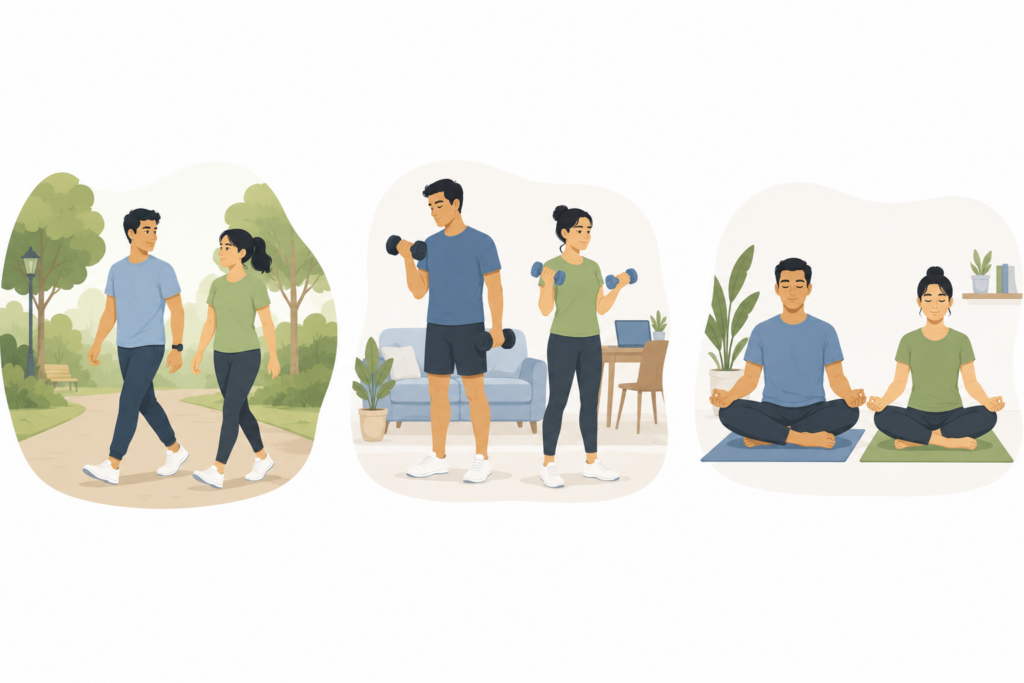
If there is one thing I truly regret, it’s this: I should have started exercising much earlier. For years I used to think, “Why break your body? Why go through pain and hard work? Body toh aaram ke liye bana hai.” I was wrong. Later I learned a very simple rule of biology:"use it or lose it".
Over time, whatever we don’t use, the body starts quietly taking away. In the same way, when we don’t use our muscles and bones—no walking, no lifting, no stretching—they slowly lose strength and quality.niams.
I strongly recommend strength training for everyone, men and women, not to become a bodybuilder but to preserve muscle and bone strength as we age. That said, in the beginning you can start with any kind of movement you actually enjoy. The best exercise is the one you will repeat most days.
Regular physical activity:
- improves strength and energy,
- reduces risk of diabetes, heart disease, obesity, and high blood pressure.
- improves sleep, mood, focus, and confidence.
Here are some Indian‑style ways to move more.
Walking (subah ya shaam ki sair)
A 30–45 minute brisk walk during sunrise or sunset can dramatically improve overall health. Even 30 minutes a day of moderate walking is linked to lower risk of diabetes and heart disease, and better brain and mental health.
Walking is the easiest and safest exercise for most people—no equipment, no gym, just shoes and a footpath.
Dancing (moving on the beats)
Dancing is exercise that doesn’t feel like “workout.” You can do it alone at home, in a dance class, at a family function—almost anywhere.
It’s a full‑body activity that also lifts your mood and keeps the brain engaged. If you already love dancing, this is your sign to start again. Steps perfect honi zaroori nahi; just move your body freely on the beats.
Sports with family or friends
Cricket, football, badminton, tennis, basketball, kabaddi—we grew up playing these. They give you a full‑body workout plus mental freshness and social connection.niams.nih+1
Playing a sport 2–3 times a week keeps the body active and the mind relaxed. If you have kids, play with them; from my own experience, it feels amazing.
Home workouts (my personal way)
Personally, I rely a lot on home workouts because my schedule is unpredictable. Whenever I get a free slot and my stomach is not full, I pick up my dumbbells, turn on the TV, open the Cult.fit app, and follow a quick session.
You can mix strength, cardio, and yoga depending on your level. You don’t need fancy equipment to start; even body‑weight exercises (squats, push‑ups against the wall, lunges) are powerful. I’ll write a full blog on home workouts for beginners soon.
Meditation and breathing as “exercise for the mind”
Just like your body needs physical exercise, your mind also needs training. In today’s world, most of us hardly use our bodies but we overload our brain with screens, meetings, and constant decisions.
If you want your new habits to survive, your mind has to become calmer and stronger. Simple breathing practices can help. For example, try a few rounds of box breathing:
- Inhale for 4 seconds,
- Hold for 4 seconds,
- Exhale for 4 seconds,
- Hold for 4 seconds again.
Even a few minutes can reduce stress and help you feel more centred. I’ll share a detailed beginner‑friendly meditation article later.
4. Evening wind‑down and sleep: turning off the noise

For many years, people around us believed that sleeping early or sleeping more is laziness. There is even that old line:
“Jo sovat hai wo khovat hai, jo jaagat hai so pavat hai.”
But most people forget the context: it was warning against oversleeping your life away, not against a healthy night’s sleep. Night sleep is not laziness — it is maintenance. Just like a machine needs cooling after continuous use, your mind and body need a proper shutdown to repair and reset.
For Indian working adults, evenings are often chaotic. Work pressure, traffic, family responsibilities, late dinners, bright screens, social media, worrying about money and tomorrow’s tasks—all this keeps the mind overstimulated even when the body is tired. Sleep suffers not because the body is weak, but because the mind never slows down. The quality of your sleep is heavily influenced by how you spend the last 1–2 hours of your day.
A simple evening wind‑down routine can:
- reduce stress hormones,
- improve sleep quality,
- support mental health,
- help physical recovery,
- and make you more productive the next day.pmc.ncbi.nlm.nih+5
Here is the evening routine I personally follow most nights. It has made a big difference to my health and to my other habits.
1) Keep dinner light and timed as well as your life allows
We already discussed earlier that eating very late and very heavy can hurt your sleep. Many of us don’t have the luxury to eat very early—but we can still make better choices.
- Try to avoid very heavy, oily, junk dinners right before bed.
- As far as possible, aim to finish dinner 2–3 hours before sleeping; late‑night eating is linked to worse sleep quality and more disturbed deep sleep.
And then there is alcohol. I slept for almost 10 years with alcohol in my system, and now I feel like I did not really sleep for 10 years. Alcohol can make you feel sleepy at first, but it reduces REM and fragments your sleep, so you wake up less refreshed and more tired over time. It looks like a friend that helps you sleep, but inside, your organs are working hard all night to clear out this toxin.
2) Slow down mentally (screens and light)
One of the simplest things you can do for better sleep is: stop heavy screen use at least an hour before bed.
- The blue light from phones, laptops, and TVs tells your brain “it is still day time” and delays melatonin, the sleep hormone.
- That means it takes longer to fall asleep and your sleep becomes lighter.pmc.ncbi.nlm.nih+1
On my own phone and laptop, I’ve set a bedtime schedule. About one hour before sleep, the screen turns grey and stays that way till my morning alarm. In my bedroom, I use warmer yellow lights in the last hour before bed. All these small signals tell my brain: “Slow down, night is coming.”
3) Light physical relaxation
Most of us work on computers all day. Our neck, back, and hips become stiff. Before bed, a little movement can help the body relax:
- a slow walk inside the house,
- or better, 5–10 minutes of light stretching or yoga.
There are many beginner‑friendly “night stretching” or “bedtime yoga” videos that guide you through simple movements. A short 5‑minute meditation or breathing practice can also calm the mind and prepare you for deeper sleep.
If you ask me, I do about 15 minutes of Yoga Nidra before sleep most nights. It feels like pressing a reset button for the nervous system. But I also started very small—with just 5 minutes of simple breathing and body scan.
4) Your bed setup matters
Where and how you sleep also matters.
- Your mattress should not be too hard or too soft; your spine needs steady support for 7–8 hours.
- The same goes for pillows; the right pillow can reduce neck pain and morning stiffness.
It may take a bit of experimenting to find what suits your body, but money spent on a good mattress and pillow is rarely wasted—it pays you back every single night.
5) Temperature and simple warm‑water tricks
Room temperature affects how fast and how well you fall asleep.
- Many experts recommend a cooler bedroom—roughly 18–22°C—for better sleep, though individual comfort can vary slightly.
- A slightly cooler environment tells your body it is time to lower core temperature, which is one of the signals for sleep.pubmed.ncbi.nlm.nih+1
Taking a warm shower or bath 1–2 hours before bed can also help. It warms the skin, and then your body cools down afterwards, which helps you fall asleep faster and improves sleep quality. On days when a full shower is not possible, even soaking your feet in warm water for a few minutes can be relaxing—I often do this myself.cnn+1
One ounce of practice
Swami Vivekananda said, “One ounce of practice is worth twenty thousand tons of big talk.” These four habits might look big from the outside, but honestly, they are not big in doing—they are big in the impact they create.
You are already doing difficult things: you studied for years, you work hard every day, you handle money, family, kids, traffic, corruption, pollution, and a hundred responsibilities. The changes I’m asking you to try are small compared to all that. And they become easier if you take them one at a time.
Bring just one change out of 4 daily habits for a healthy life – morning, food, exercise, or sleep. When you feel the benefit, the rest will follow.
Habits are automatic. Once these become your habits, the benefits will keep coming, like a farmer who sows a tree once and then enjoys the fruits for years.
If you truly read till here, I know you are serious about changing something. You don’t need to master all 4 daily habits for a healthy life in one week—just pick one habit and repeat it until it becomes part of your normal routine.
Tell me in the comments: which one of these 4 daily habits for a healthy life—morning, food, exercise, or sleep—feels most broken for you right now, and what is one small change you’re willing to try this week?
Once you reply, we can build from there together.
If this helped you even a little, save it or share it with one person who needs it. And if you want more simple, honest posts on health habits and safe investing for Indian working adults, you can join my email list on the site’s homepage so you don’t miss the next one.
References and further reading
Habits & behaviour change
- How to form a habit – (https://www.bps.org.uk/research-digest/how-form-habit) – British Psychological Society summary of research showing that habits can take on average around 66 days to feel automatic, with big differences between people.
- Behavior modification for lifestyle improvement – (https://www.ncbi.nlm.nih.gov/books/NBK592418/) – StatPearls review explaining why intention alone is not enough and how structured plans and relapse‑recovery help long‑term change.
Sleep, circadian rhythm & light
- Get morning light, sleep better at night – (https://www.webmd.com/sleep-disorders/features/morning-light-better-sleep) – WebMD overview of how morning light helps reset your internal clock and supports better sleep.
Nutrition, meal timing & sleep
- Beneficial effects of a higher‑protein breakfast – (https://pubmed.ncbi.nlm.nih.gov/23446906/) – Clinical study showing that a high‑protein breakfast improves fullness, appetite hormones and reduces evening snacking.
- The effects of time‑restricted eating on sleep in adults (https://www.frontiersin.org/journals/nutrition/articles/10.3389/fnut.2024.1419811/full) – Review noting that eating very close to bedtime (within about 1–3 hours) is linked with more awakenings and lower sleep efficiency.
Physical activity & movement
- Physical activity – World Health Organization – (https://www.who.int/initiatives/behealthy/physical-activity) – WHO summary of why regular movement is essential for health.
- -WHO guidelines on physical activity and sedentary behaviour (https://www.ncbi.nlm.nih.gov/books/NBK566046/) – Official recommendations for adults to get 150–300 minutes of moderate activity per week plus at least two days of muscle‑strengthening work.
If you truly read till here, I know you are serious about changing something.
Tell me in the comments: which one of these four areas—morning, food, exercise, or sleep—feels most broken for you right now, and what is one small change you’re willing to try this week?

Abhishek Sikka writes for Indian working adults who want better health habits and safer money decisions. He shares practical lessons from his own lifestyle changes and years of market experience, with a focus on realistic routines, clear thinking, and long-term progress over extremes.
Discover more from
Subscribe to get the latest posts sent to your email.