
Table of Contents
It is well past ten. The puja is done, the house smells of diya smoke and agarbatti, and a plate lands in front of you: dal, sabzi, puri, and two jalebis balanced on the rim. You have been sitting since morning. Everyone is hungry, everyone is happy, and nobody is going to eat early tonight.
I know the other end of this story. In my corporate years I carried a belly, with poor sleep, high stress and messy food all sitting in the same frame. Regular workouts changed that, and I have written about it in my belly fat article. This piece is narrower. It is about the next two weeks, the late dinners and the mithai, and how to avoid sugar spike during diwali without becoming the person who refuses prasad.
Key Takeaways
- Diwali week is a pile-up of boxes, hampers and late dinners, not one bad sweet, so fix the pattern and not the piece.
- Sugar-free mithai is not calorie-free or carb-free; khoya, ghee and nuts still add up.
- Aim for dinner by 8:30-9pm, or keep the late meal small and let protein and vegetables lead.
- Sweets go last, after a real meal, in a small dry piece, followed by a 10-minute walk.
- Get a baseline fasting glucose or HbA1c now if you are at risk, and keep three simple rules for 14 days.
Why Diwali Week Is a Pile-Up, Not One Sweet
Nobody’s sugar goes wrong because of one laddu. It goes wrong when the office box, the gifted hamper, the puja prasad, the cousin’s house visit and the 10pm family dinner all land on a body that has been sitting for ten hours. Each looks small. Together they are a week-long pattern.
This matters more than most of us assume. In the national ICMR-INDIAB study, the weighted prevalence of diabetes was 11.4% and prediabetes 15.3%, which a National Medical Journal of India summary translates to roughly 101 million and 136 million people. An earlier 15-state INDIAB paper found that 47.3% of people identified as having diabetes had not been diagnosed before. These are survey data collected over several years, so read them as a pattern and not as today’s exact rate. The pattern is that many people carry a borderline number without knowing it, and that is why I suggest a baseline test further down.
The Sugar-Free Myth, Calmly
This week’s Diwali coverage is full of sugar-free versus regular mithai stories, and the dietitians quoted keep making the same point: sugar-free does not mean calorie-free or carb-free. A Diwali explainer notes that khoya, nuts, cream and ghee still supply plenty of calories and fat, and that the carbohydrates can still affect blood sugar. Check the nutrition panel, not the front-of-pack claim.
| What the label suggests | What is usually true |
|---|---|
| Sugar-free means carb-free | Khoya, dry fruit and refined flour bases still carry carbohydrates, so the panel matters more than the claim (source). |
| Sugar-free means calorie-free | Some shops simply swap sugar for nuts or ghee, so calories stay high (Business Standard). |
| Jaggery or dates make it healthy | Dietitians say jaggery and palm sugar sweets carry essentially the same carbohydrate and glucose load (source). |
| Stevia or sugar alcohols solve it | They reduce the sugar load but can still add fat, and polyols can upset the stomach, so go gently (source). |
So treat a sugar-free piece as a middle-tier sweet, portion it like a regular one, and stop thinking of it as a free pass. There is no standard recipe across Indian shops either. Ghee, mawa and nut choices can shift calorie totals by 30-50 per cent, according to Business Standard, which is why every calorie number below is approximate.
The 9:30pm Problem: how to avoid sugar spike during diwali when dinner runs late
Here is what the late-dinner research actually says, without drama. In a randomised crossover trial in healthy volunteers, the same people ate dinner at 10pm on one occasion and 6pm on another, with the same fixed sleep window. The late dinner produced higher glucose, a delayed triglyceride peak, lower fat burning and higher cortisol. An investigator quoted by Medscape put the peak glucose at about 18% higher and overnight fat burning about 10% lower. A Japanese crossover study with a 9pm versus 6pm dinner also found a difference in 24-hour glucose, though it had only 12 participants. Another trial in young men on a delayed eating schedule saw high night-time glucose carry into the next morning.
Now the honest limits. These trials are small, mostly young and healthy people, and in the US and Japan. They compared 6pm with 9 or 10pm. None tested 8:30 versus 9:30. The main trial also found no change in sleep structure, only the higher glucose and cortisol, so I am not going to tell you a late dinner wrecks your sleep. And no trial tested a single festival night. So dinner by 8:30-9pm is a practical compromise, not a proven threshold. It is simply a line that most working households can hold on most days.
Late is not the villain. Late and heavy is. On the evenings that must run late, make the late meal the small one.
When puja forces a 10pm meal, here is what tends to help:
- Eat the bulk of your food earlier, an early protein-rich evening meal around 6:30-7pm, and keep the late meal small. This is a suggestion drawn from a small study in young healthy women where dividing a late dinner reduced glucose swings, so treat it as a sensible idea and not a proven protocol.
- Let dal, paneer, eggs, curd or sabzi lead the plate, with a small portion of puri or rice.
- Keep sweets to one small dry piece, if any.
- Do not skip lunch or dinner to save room for mithai and then arrive starving at the puja meal. That is my reasoning and not a tested result, but it is a very common way plans fall apart.
The Mithai Hierarchy: Syrup-Soaked Versus Dry
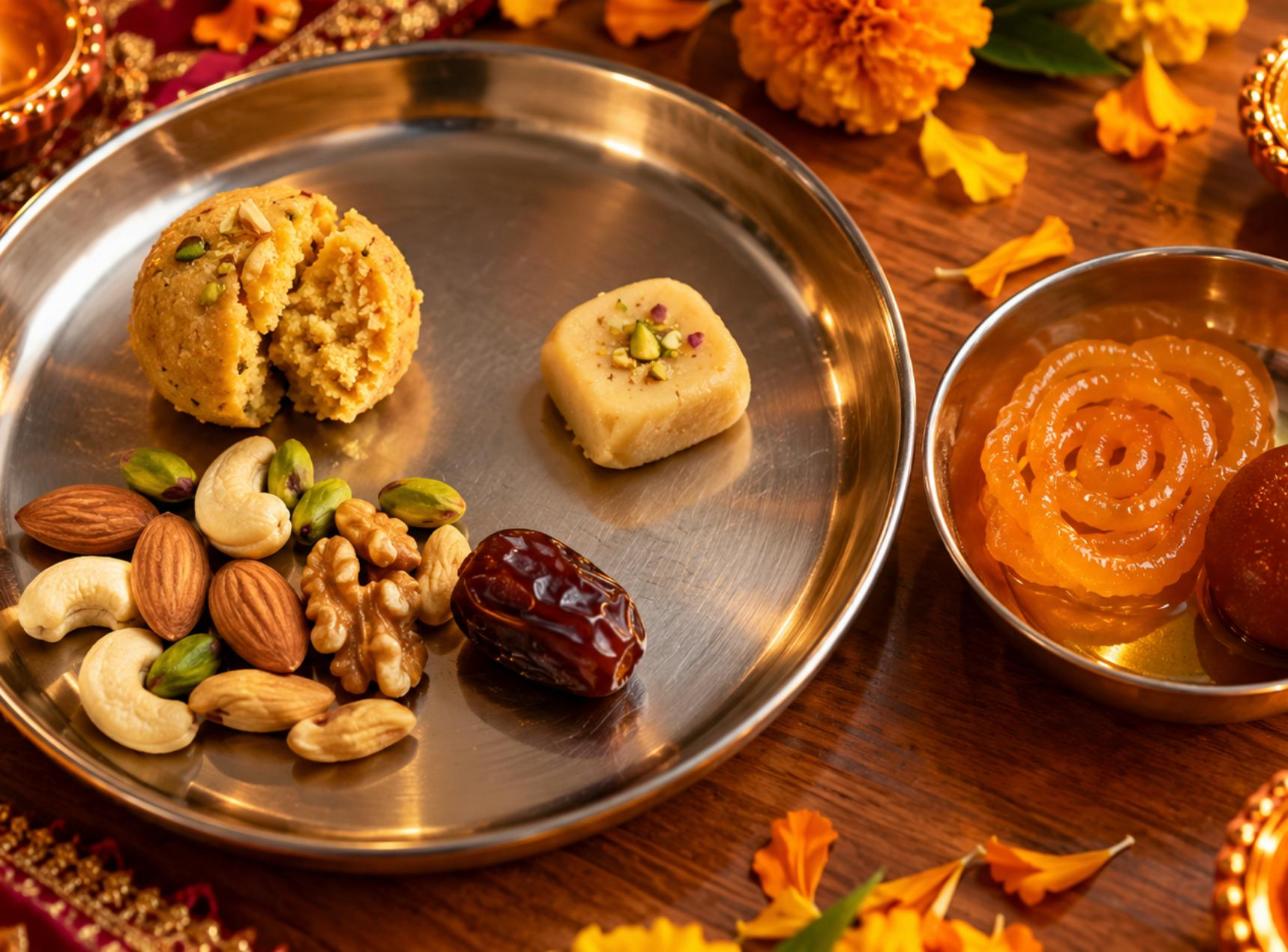
Here is a simple way to rank mithai: how much syrup it carries, and whether the base is fried refined flour or something like besan or nuts. I have not found a published glycaemic-index study of specific mithai, so this ranking is sugar-load and format logic, a practical order and not a measured list. Calories below are rough ranges from a commercial Indian food chart, and your halwai’s version will differ.
| Tier | Examples | Suggested portion | Rough calories |
|---|---|---|---|
| Top: best of the lot | Besan laddu, date-nut roll with no added sugar, small kaju katli or badam piece, roasted nuts with one date | Half a laddu (about 20 g), or 1-2 small pieces | A full 40 g besan laddu is about 160-200 kcal, so half is roughly 80-100 |
| Middle | Peda, barfi, coconut laddu, plain milk-based dry sweets, any sugar-free mithai | 1 small piece (about 25-30 g) | Varies widely; khoya and ghee do the work |
| Bottom: syrup-soaked | Jalebi, gulab jamun, rasgulla, imarti, balushahi | Skip, or one taste: half a piece, lightly drained, only after a meal | Jalebi (2 pieces) 150-200; gulab jamun (about 50 g) 140-175; rasgulla (about 60 g) 100-130 |
Two traps inside this table. First, rasgulla looks light on calories, but it is mostly sugar syrup, so a lower calorie count does not mean a lower sugar load. Second, the top tier is dry but calorie-dense, so portion matters more than the label. Kaju katli is the classic example: light per piece, dense per gram, as a kaju katli calorie guide explains. And a date is not a free pass; one is plenty.
You know the voice that says, “Bas ek jalebi, kya farak padta hai?” One piece genuinely does not matter much. The plate of four after a 10pm dinner does. Decide the number before you sit down.
Sequencing: Protein and Fibre First, Mithai Last, Then Walk
Order may matter as much as the item. In a small study from Weill Cornell, people with obesity and type 2 diabetes had glucose about 29%, 37% and 17% lower at 30, 60 and 120 minutes when vegetables and protein were eaten before carbohydrates. A pilot in prediabetes found the habit easy to follow for most people, and a systematic review in healthy adults found that most studies showed lower post-meal glucose with fibre or protein first, though the effect size varied. None of these tested mithai, so applying it to dessert is a reasonable extension, not a proven result.
In practice, that means three small habits:
- Protein and fibre first. Salad, sabzi, dal, paneer, eggs or curd before the roti or rice.
- Mithai only after a meal. Never alone at your desk on an empty stomach. This is practical reasoning, not a tested rule, but a sweet after a proper meal behaves very differently from one with 4pm chai.
- Walk 10 minutes after eating. A review of short walking breaks found that light walking lowered glucose by about 17% compared with sitting, and standing by about 9%. Those studies used 2-5 minute breaks every 20-30 minutes. Treat 10 minutes as the target and 2-5 minutes as the fallback on a bad day.
One caution: the walk helps, but it does not cancel a four-piece plate. The evidence shows a modest reduction, not erasure. Do not turn it into a licence.
The Office Box and the Gifted Hamper
If you sit at a desk, the mithai box is the quiet one. Nobody forces it on you; it just sits within arm’s reach and gets opened at 4pm with chai. What tends to work:
- Move the box away from your desk, to the pantry or a shared table.
- Have one piece with lunch, after the meal, not at 4pm.
- If you are passing the box on or re-gifting, pick the dry pieces for yourself first.
- Read the date on packaged boxes. FSSAI requires loose sweets to display a best-before date (a manufacture date is optional), as this summary of the order explains. I have not checked for newer orders, so look at the box itself.
- For hampers, split the contents: dry fruit and roasted nuts for the week, sweets for the weekend, and share the rest.
- Keep a protein snack ready for the 4pm dip: roasted chana, nuts, curd.
That last one is where my own kitchen story comes in. My old kitchen was full of biscuits, instant noodles, namkeen and soft drinks. As a child I was even the one sent to the kirana shop for glass soda bottles when guests arrived, because that is what hospitality looked like. These days evening biscuits have given way to fruit, homemade chana chaat, and roasted makhana and chana. I am not saying it is a perfect system; I am saying the 4pm hand reaches for whatever is closest, so what is closest matters. I wrote more on this in my ultra-processed food article.
A Quick Pre-Diwali Check: Baseline Now, Repeat in December
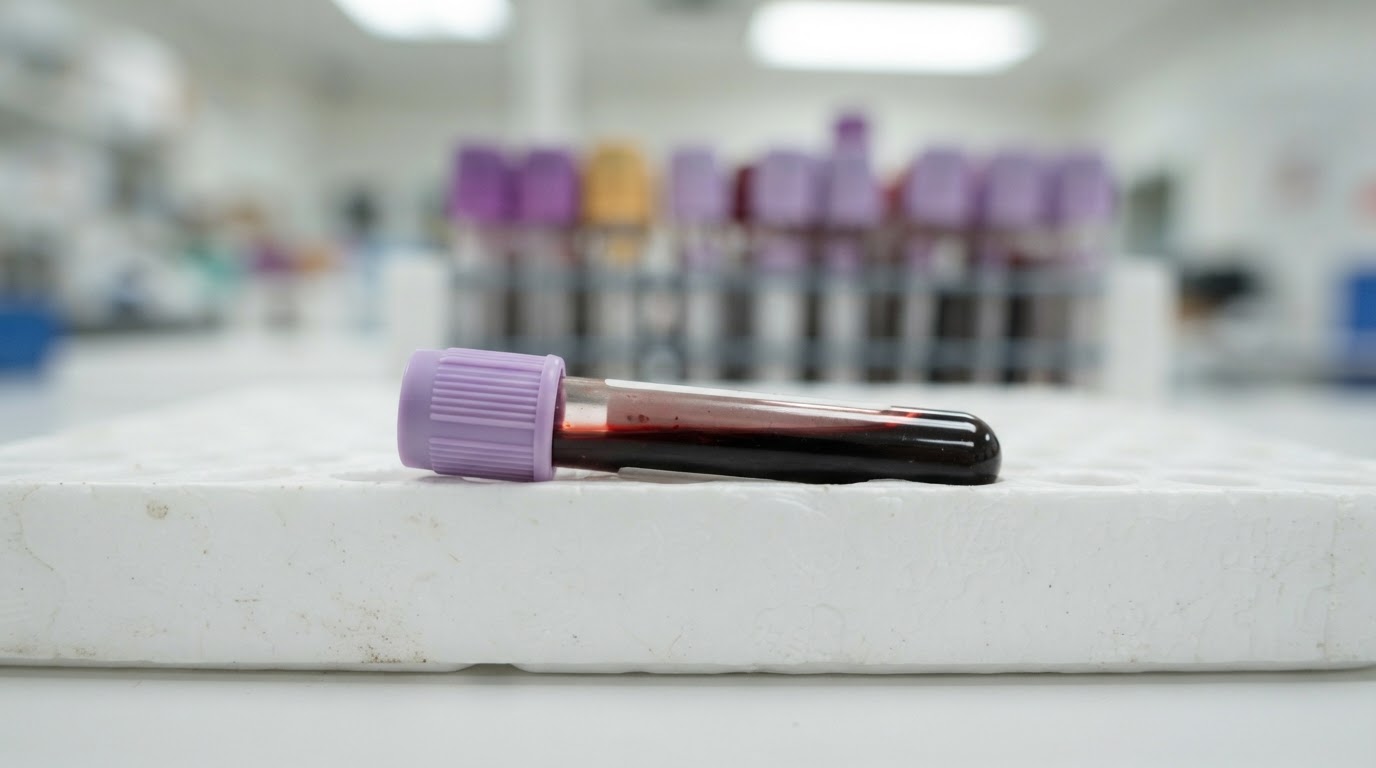
If you have a family history of diabetes, a growing waist or an earlier borderline result, get a baseline before Diwali, ideally this week. A fasting glucose and an HbA1c at a reputable accredited lab will do. Fasting glucose needs about eight hours without food, while HbA1c can be done on a single non-fasting sample.
For reference, the American Diabetes Association lists prediabetes as a fasting glucose of 100-125 mg/dL or an HbA1c of 5.7-6.4%, and recommends screening for adults aged 35 and older, per the ADA Standards of Care. Different labs and guidelines draw lines slightly differently, so do not self-diagnose from one number. A single borderline reading is not a diagnosis, and tests are normally repeated before anyone concludes anything.
Timing matters here. HbA1c reflects roughly the past two to three months, as the Endotext chapter on prediabetes describes, so an HbA1c in early December will show very little of a two-week festival. My suggestion is to recheck fasting glucose in early December and repeat HbA1c around three months after your baseline. That is my own reasoning, so treat it as a plan to confirm with your physician. If your result is abnormal, or you take diabetes medication, talk to your own doctor about next steps and meal timing instead of adjusting anything yourself. More on this in my Preventative Health and Lab Tests series.
The 14-Day Plan: Three Rules That Survive a Working Day
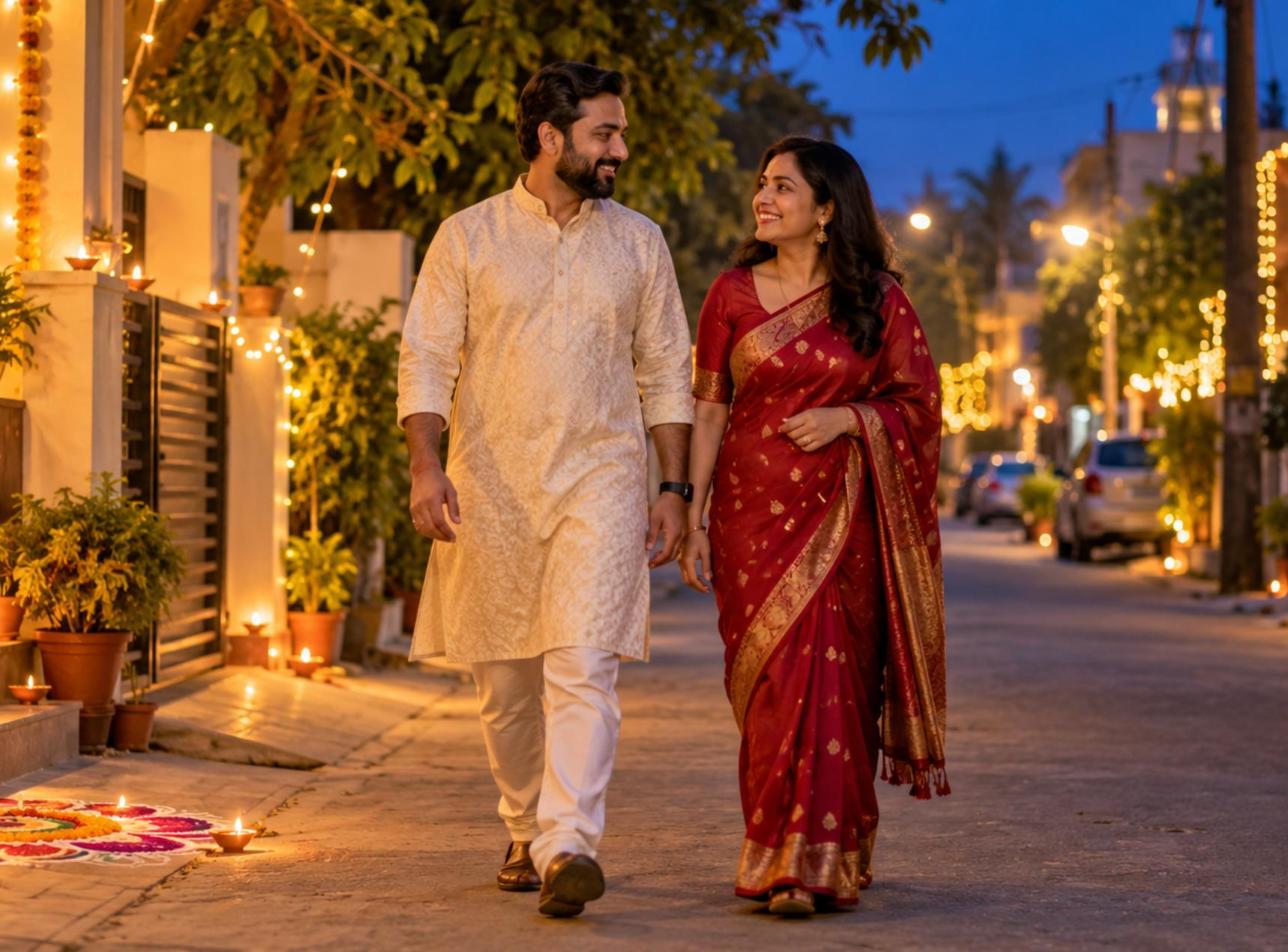
Day 1 is Monday 26 October and Day 14 is Diwali, Sunday 8 November. Shift it if you are starting late. Do the baseline test this week so it is out of the way. The whole plan runs on three rules:
- Dinner by 8:30-9pm, or go light. If it must be late, protein and vegetables first, a small carb portion, and at most one small dry piece.
- Mithai only after a meal. One piece from the top or middle tier, never on an empty stomach.
- Walk 10 minutes after lunch and dinner. On a bad day, 2-5 minutes of standing or walking counts.
| Days | Focus |
|---|---|
| 1-3 | Confirm your baseline test. Pick your dinner cut-off time. Start the post-lunch walk. |
| 4-7 | Add the post-dinner walk. Start every lunch and dinner with protein and vegetables. |
| 8-10 | Handle the office box with the pantry rule and one piece after lunch. Plan the puja-day meals in advance. |
| 11-13 | Practise the light late dinner on any evening that runs late. |
| 14 (Diwali) | Eat normally and enjoy it. Apply the three rules, not perfection. Aaj Diwali hai, thoda enjoy karo. |
| After | Keep the same rules through Bhai Dooj. Recheck fasting glucose in early December if you are at risk. |
Three rules you keep for fourteen days will do more than ten rules you drop by Day 4.
Frequently Asked Questions
Is sugar-free mithai a safe choice if I am worried about sugar?
It lowers the sugar but not necessarily the carbohydrates or calories, since khoya, nuts and ghee still count. Read the nutrition panel and portion it like regular mithai.
Is a 10pm dinner really that harmful?
In small trials, late dinners led to higher glucose and cortisol than early ones. No trial tested a single festival night, so there is no reason for alarm. The sensible takeaway is to make late meals lighter. Chalta hai, baad mein dekhenge works for one night; it is a bad plan for every night.
Is a 10-minute walk after meals enough?
Short walks improved glucose responses in the studies above, and walking beat standing, which beat sitting. It is a helpful habit, not a way to cancel extra mithai.
I have diabetes or take medication. Do these rules apply to me?
These are general ideas, not medical advice. Ask your own doctor about meal timing, medication and late dinners before changing anything, especially skipping or shifting meals.
The Honest Takeaway
Knowing how to avoid sugar spike during diwali is less about willpower and more about a few small structures: an earlier or lighter dinner, protein before sweets, a short walk, and a box that is not on your desk. Some of this evidence is small and none of it is a guarantee, so keep your expectations calm. Pick the three rules, get your baseline if you are at risk, and enjoy the festival. If you want the longer view, my pieces on belly fat and ultra-processed food go deeper into what happens after the festival ends.
If you truly read till here, I know you are serious about changing something.
Tell me in the comments: which part of this feels most relevant or confusing for your current situation, and what is one step you are taking this month?
Leave a comment below – I genuinely read them, and your question might also help someone else facing the same situation.

Abhishek Sikka writes for Indian working adults who want better health habits and safer money decisions. He shares practical lessons from his own lifestyle changes and years of market experience, with a focus on realistic routines, clear thinking, and long-term progress over extremes.
Discover more from
Subscribe to get the latest posts sent to your email.