

Most people think investing is where financial security begins.
I used to think the same.
I started investing fairly early in life. My portfolio looked decent on paper—some stocks, a bit of real estate exposure, and money lent to a friend’s business as a short‑term loan. It felt good to sleep at night knowing “my investments are working for me.” But one day, the main client my company was serving decided to shut down its business in India. That meant our jobs were at serious risk, even though initially we were told everything was under control.
But in reality we lost the job and fixed monthly income.
Meanwhile, my EMI’s, monthly expenses, and family responsibilities were still there. Because I had no emergency fund, I was forced to sell some of my investments at the worst possible time and at a loss, just to manage day‑to‑day expenses.
That experience taught me something I wish I had understood much earlier:
Financial security isn’t built by earning more or investing aggressively. It starts with having a solid safety net.
Before we talk about SIPs, mutual funds, stock markets, or wealth creation, we need to talk about something far less exciting—but far more important.
Your Emergency Fund.
For many professionals, an emergency fund in India is the difference between a temporary setback and a full‑blown financial crisis.
And ironically, building one can make you a much better investor.
Table of Contents
Emergency Fund in India: What It Is and Why It Matters
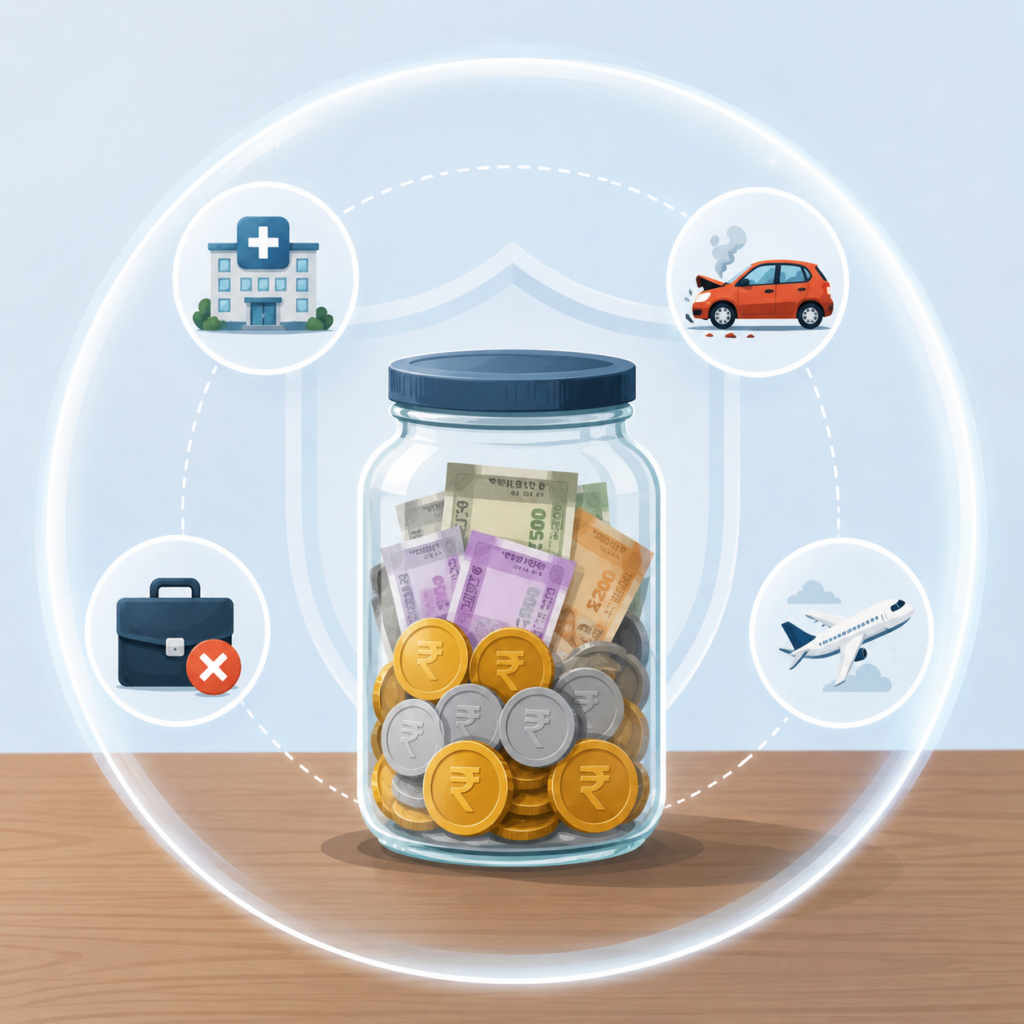
An emergency fund is money kept aside only for unexpected situations that need immediate financial support.
This is not money for:
- Exotic vacations
- The latest smartphone
- Festival shopping
- A new SUV upgrade
An emergency fund exists for life’s surprises, such as:
- Sudden job loss
- Unexpected medical emergencies
- Family emergencies
- Major home repairs
- Unavoidable travel
- Sudden loss of wealth
Think of it as your financial shock absorber.
When life hits you with something unexpected, your emergency fund takes the impact so your long‑term investments don’t have to.
Indians Have a Long History of Saving for Emergencies

Did You Know?
For generations, Indian households have preferred bank deposits, cash, and gold as their primary savings vehicles. While the tools have changed over time, the underlying idea remains the same: keep a financial buffer for uncertain times.
An emergency fund is simply the modern version of that habit.
Long before the term emergency fund became popular in personal finance, Indian families were already practicing it in their own way.
Most of us grew up watching our parents and grandparents save money for “bad times.” They may not have called it an emergency fund, but they always believed in keeping something aside for unexpected situations. Sometimes it was cash kept safely at home, sometimes a savings account, a fixed deposit, or even gold accumulated over many years.
I remember hearing phrases like:
“Beta, kuch paise hamesha bure waqt ke liye bacha kar rakhne chahiye.”
That mindset did not come from financial books or social media. It came from experience.
For generations, Indian families understood a simple truth: life is unpredictable. Jobs can be lost, businesses can slow down, medical emergencies can happen, and unexpected expenses often arrive without warning.
In fact, several studies and industry reports have noted that saving has traditionally been deeply rooted in Indian culture. For decades, households preferred keeping money in bank deposits, cash, or gold because these assets were easily accessible during emergencies. Even today, savings accounts remain one of the most common places where families keep money they may need quickly.
The irony is that while our parents and grandparents were often disciplined savers, many young professionals today earn significantly more but maintain much smaller financial buffers. Easy credit, EMIs, buy-now-pay-later offers, and lifestyle inflation have slowly replaced the habit of keeping cash reserves for difficult times.
The concept of an emergency fund in India is therefore not a new financial invention. It is simply a modern and more structured version of a habit that Indian families have followed for generations.
Why Most Young Indians Ignore Emergency Funds

As we discussed above Emergency funds in India or savings is deeply rooted in our Indian culture and is one of the most important parts of personal finance, yet most new age young people quietly skip them.Economic Survey 2025–26
There are a few reasons.
1. Investing Feels More Exciting
Building an emergency fund isn’t glamorous anymore.
No one posts screenshots of “6 months of expenses in a savings account” on social media. You rarely see YouTube thumbnails promising “Become Crorepati with an Emergency Fund”.
Investing looks more exciting because growth is visible. Safety doesn’t feel exciting—until you need it.
For the full safe Investing roadmap I follow (emergency fund, insurance, and simple long‑term investing), read my guide: How I’d Start Investing Safely in India if I Had to Begin Again
2. We Assume Bad Things Won’t Happen
Most of us believe tomorrow will look like today:
- Stable job
- Regular montly salary
- EMIs getting auto debit
- Normal monthly expenses
But the last few years, COVID, layoffs, business closures and now Artificial intelligence (AI), have shown how quickly things can change.
3. Credit Cards Create a False Sense of Security
Look, we’ve all been there. When an unexpected medical bill or car repair hits, that shiny piece of plastic in your wallet feels like a financial lifesaver. It’s incredibly easy to view a credit card as a “backup emergency fund.” But treating it like a safety net is a massive trap.
Here is the honest truth: a credit card is not an emergency fund; it is a high-interest loan waiting to happen.
When you use actual savings for an emergency, it costs you zero rupees. When you swipe a credit card and can’t pay it off fully by the due date, you fall into a brutal cycle:
- Insane Interest Rates: Indian credit cards charge 36% to 48% annual interest on unpaid balances. That is higher than almost any other type of loan. CRIF
- The “Minimum Due” Illusion: Paying just the 5% minimum keeps the bank from penalizing you, but it doesn’t clear your debt. The remaining 95% compounds daily, meaning you are barely paying off the interest while the principal debt stays untouched.
- The Grace Period Vanishes: The moment you carry a balance into the next month, your 45-to-50 day interest-free window is canceled. Every new swipe—even just for groceries—starts racking up heavy interest from the exact second you pay.
Credit cards are great for reward points if you pay them off in full every month. But using them to bridge a genuine financial crisis isn’t a solution—it’s just trading one emergency for a much bigger, more stressful one. True peace of mind comes from building a real emergency fund, so you are relying on your own money, not a bank’s expensive trap.
How an Emergency Fund Makes You a Better Investor

This is the part that surprises many people.
An emergency fund is not only about protection. It can directly improve your investing behaviour.
1. You Don’t Have to Sell Investments During Market Crashes
Imagine the market falls 25%. At the same time, you face a medical emergency or a temporary job loss.
Without an emergency fund, you may be forced to:
- Break FDs at the wrong time
- Stop SIPs suddenly
- Sell long‑term investments at a loss
That’s how a temporary decline becomes a permanent loss.
With an emergency fund, you get time. Your investments can stay invested while you handle life with cash.
2. You Can Stay Invested for the Long Term
Successful investing is often less about picking perfect products and more about staying invested.
That becomes easier when you know your next few months of basic expenses are already covered in cash. You can focus on long‑term goals instead of reacting to every short‑term shock.
3. You Sleep Better
Money stress doesn’t just live in your bank account. It affects:
- Sleep
- Relationships
- Focus at work
- Overall mental health
Knowing that several months of expenses are already taken care of creates a quiet confidence that high returns alone cannot give.
How Much Emergency Fund Do You Really Need in India?
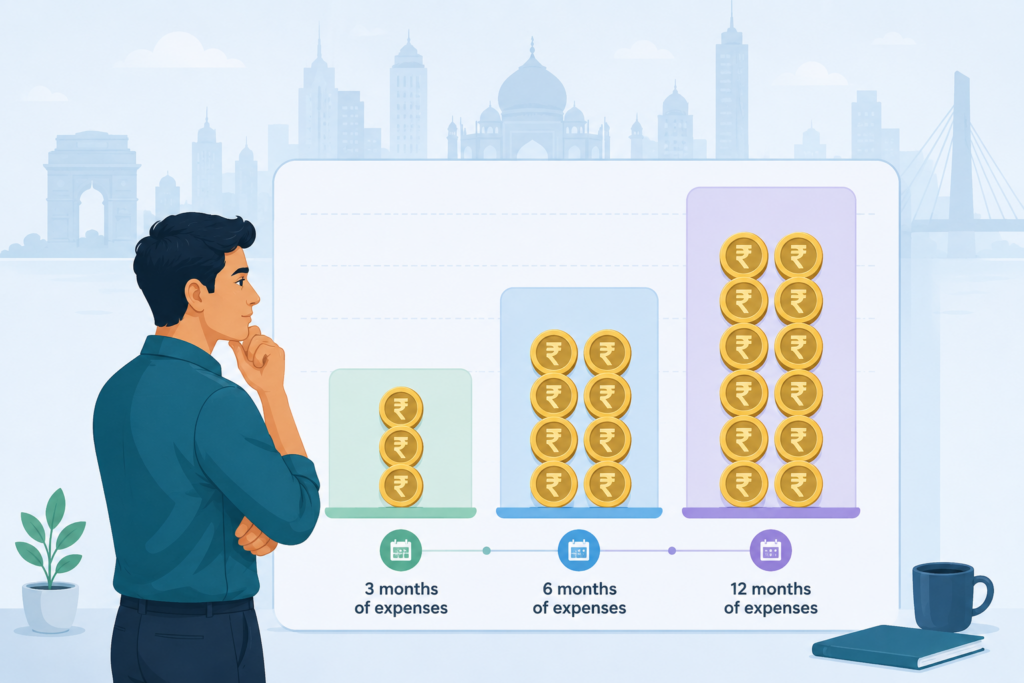
The right size of an emergency fund in India depends on your profession, family responsibilities, and income stability.
There is no single number that fits everyone. The right amount depends on your:
- monthly expenses
- job stability
- number of dependents
- EMIs and other fixed commitments
But some practical guidelines help.
Single Professionals
Aim for 3 to 6 months of essential expenses.
If your monthly expenses are around ₹40,000:
- Minimum target: ₹1.2 lakh
- Stronger cushion: ₹2.4 lakh
Married Professionals
Aim for 6 to 9 months of expenses.
A family usually has:
- Higher fixed costs
- More responsibilities
- Less flexibility in emergencies
Single‑Income Households
Aim for 9 to 12 months of expenses.
If multiple people depend on one salary, a larger buffer becomes critical.
The goal isn’t to hit a perfect number on day one. The goal is to slowly move from no cushion to a meaningful cushion.
How to Build an Emergency Fund Without Feeling Overwhelmed

One big reason people avoid this step is that the final target looks huge.
A ₹3–5 lakh goal feels intimidating when you’re starting from zero.
The solution is simple: stop thinking in one giant leap.
1. Automate Your Savings
Set up an automatic transfer every month right after your salary is credited.
Think of a bank Recurring Deposit (RD)
It is your automated financial safety net. Instead of relying on a risky credit card, an RD lets you set aside a fixed amount—say ₹2,000 or ₹5,000—automatically from your salary account every single month. It completely takes the discipline guesswork out of the equation while you build a real emergency fund in India, where unexpected medical bills or sudden expenses can easily throw off your budget.
Because your money is locked away for a set period earning guaranteed interest, you aren’t tempted to casually spend it. Yet, if a real crisis hits, you can break the RD instantly through your mobile banking app. It’s the perfect, stress-free way to stack up your own cash, so you never have to borrow from a bank at 40% interest just to get out of a tight spot.
2. Use Bonuses and Extra Income
Annual bonuses, incentives, tax refunds, or side income can speed up the process.
Instead of spending all of it, decide in advance:
- “At least 30–50% of any bonus will go into my emergency fund.”
3. Focus on Milestones, Not Just the Final Number
Break the journey into smaller wins:
- First ₹25,000
- First ₹50,000
- First ₹1,00,000
- 3 months of expenses
- 6 months of expenses
Each milestone you reach reduces your financial stress a little more.
Where Should You Keep Your Emergency Fund?
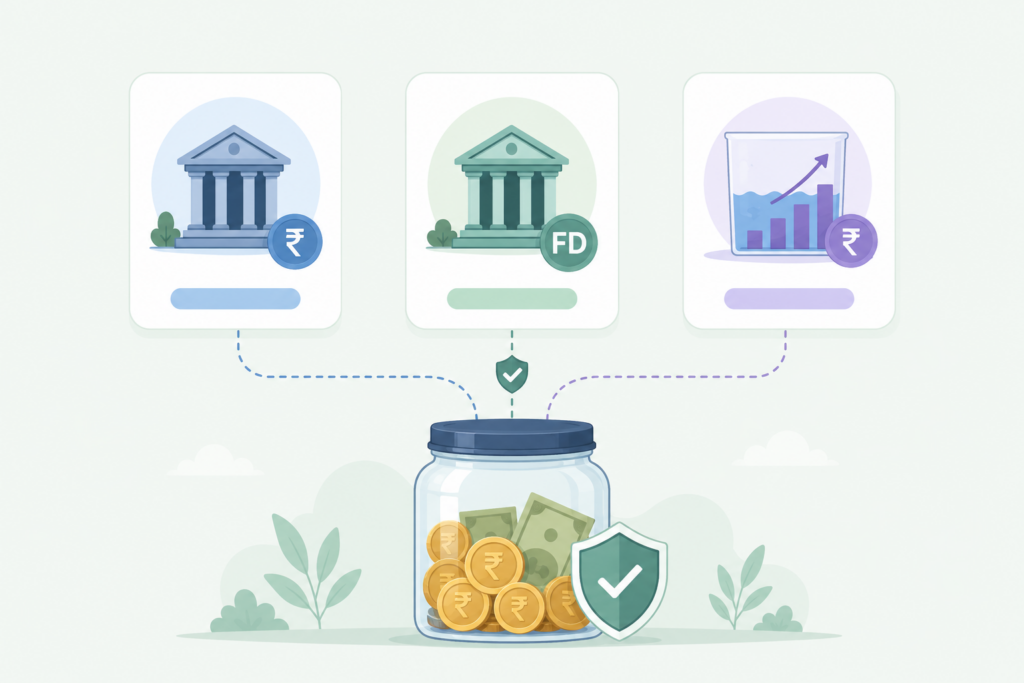
The purpose of an emergency fund is safety and accessibility. Growth is a bonus, not the main goal.
1. Savings Account
A traditional Savings Account is the bedrock of any financial safety net. It is the most straightforward, no-nonsense place to park a portion of your emergency fund in India because it offers something no other financial tool can beat: absolute, split-second accessibility.
- Zero Friction: When an emergency happens at 2:00 AM, you don’t want to worry about breaking an investment or waiting for a fund transfer. Money in a savings account is ready instantly for a UPI payment, debit card swipe, or ATM withdrawal.
- Guaranteed Safety: Your money is completely insulated from market crashes. Plus, under the DICGC (a subsidiary of the RBI), your deposits up to ₹5 lakh per bank are fully insured, giving you total peace of mind.
- Decent Earnings: Many newer private banks and digital banks in India offer highly competitive interest rates (sometimes up to 6% or 7% depending on the balance), meaning your emergency cash doesn’t just sit idle; it still fights off inflation.
It might feel old-school, but keeping at least one or two months’ worth of living expenses in a dedicated savings account ensures you have immediate cash flow to handle a crisis without ever having to touch a credit card.
2. Sweep / Auto‑Sweep Fixed Deposits
If you want your money to work extra hard while still being there for a rainy day, an Auto-Sweep Fixed Deposit is an absolute game-changer. It basically bridges the gap between a regular savings account and a high-yield FD. Here is why it is arguably the smartest tool to build an emergency fund in India:
- Best of Both Worlds: Your bank automatically moves any money above a certain limit (say ₹25,000) into an FD that earns much higher interest, but the leftover cash stays in your savings account for daily use.
- Instant Liquidity (No Penalties): If an emergency hits and you need to swipe your debit card or withdraw cash, the bank automatically “breaks” just the exact amount you need from the FD portion. There are no manual premature withdrawal hassles or heavy penalties.
- No Idle Cash: It completely automates your savings discipline. You don’t have to keep manually moving money around; the system ensures your hard-earned cash is never sitting idle earning a measly 3% interest.
It’s the ultimate lazy-person hack for financial security. You get the high interest rates of a fixed deposit, but your money remains 100% accessible whenever life throws a curveball at you.ddenly need.
3. Liquid Mutual Funds
For people who want a slightly more advanced option than a standard bank account, Liquid Mutual Funds are a phenomenal vehicle for building an emergency fund in India. They offer a blend of professional management and top-tier security, allowing you to beat basic inflation without taking on major risks.
- Ultra-Low Risk Profile: These funds strictly invest in high-quality, short-term government and corporate debt instruments that mature in 91 days or less. Because the timeline is so brief, they are incredibly stable and insulated from stock market crashes.
- Better Returns Than Savings Accounts: While a standard savings account might yield 3% to 4%, liquid funds historically deliver stabler, market-linked returns usually hovering around 6% to 6.5%, giving your emergency cash a much-needed boost.
- The 24-Hour Redemption (with a catch): If you request a withdrawal on a business day, the money is usually credited back to your bank account within 24 hours (T+1 basis). Many top asset management companies even offer “instant redemption” tools that let you withdraw up to ₹50,000 immediately at any time of day.
Important Caveat: To get the most out of a liquid fund, keep a tiny portion of your emergency money in cash or a savings account for immediate midnight emergencies. Liquid funds charge a tiny, tiered exit fee if you withdraw your money within the first 7 days of investing—but from day 8 onward, it is completely free to withdraw. Also, note that the gains are added to your overall taxable income and taxed according to your personal income tax slab rate.
It is the perfect choice if you want your emergency stash to earn a little extra interest while keeping it safely out of arm’s reach of your daily impulse spending.t remain the priority.
Where Not to Keep Your Emergency Fund
Avoid keeping your emergency money in:
- Individual stocks – Any bad news can vanish most value
- Small‑cap or sector funds – Very volatile in nature
- Cryptocurrencies – Worst place to park emergency money
- Real estate – Not liquid at all
- Long lock‑in products – Liquidity issue
If the value can drop sharply right when you need it, it’s probably not the right place for your emergency savings.
Common Emergency Fund Mistakes
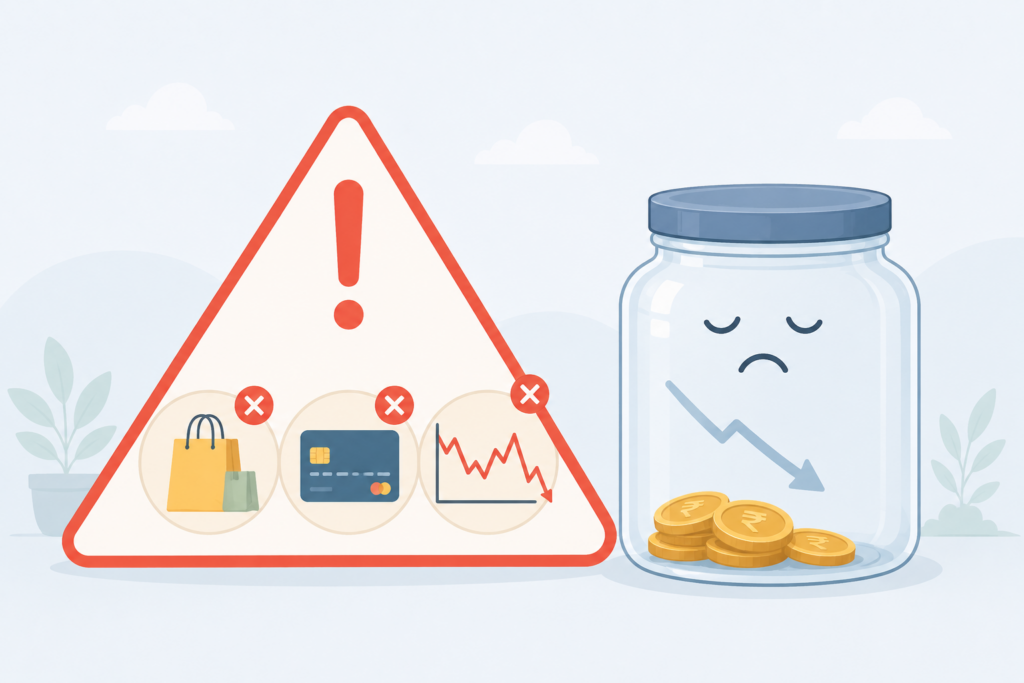
Even with the best intentions, it’s incredibly easy to mismanage your financial safety net. If you want to avoid a massive reality check when things go sideways, you need to watch out for these trap doors when building an emergency fund in India.
The “SIP First, Safety Net Later” Blunder:
In a world that screams “start a SIP” every single day, this might sound a bit controversial. But jumping straight into aggressive mutual funds without a cash cushion is a recipe for disaster. The smartest move for a beginner is to build a basic cash baseline first, and then aggressively scale up your investments. Having that solid foundation ensures you won’t be forced to pull money out of the stock market at a loss during a sudden correction.ections.
Chasing Returns Instead of Safety:
The second you invest your crisis money into high-risk instruments for better yields, you stop having a safety net and start having a gamble. The primary purpose of this money is strict protection, not peak performance. If a market crash hits at the exact same time you lose your job, a volatile investment will leave you completely stranded.
The “Convenient Emergency” Slip:
A flash sale on a new iPhone, a discounted Goa trip, or festive shopping deals do not qualify as emergencies. This money is exclusively reserved for genuine lifestyle disruptions: sudden job loss, unexpected medical bills, or critical household repairs. If it isn’t a crisis, don’t touch it.
The “Set It and Forget It” Blindspot:
Your financial life isn’t static. As your lifestyle, inflation, and responsibilities grow, your survival number has to adapt. Make it a habit to review your safety fund at least once a year—especially when you get a major salary hike, move to a more expensive city, get married, or welcome a child.
This Week’s Simple Action Plan
If you want to start but feel overwhelmed, do just this:
- Calculate your essential monthly expenses (rent/EMI, groceries, utilities, basic transport, basic insurance).
- Decide a first target — even 1 month of expenses is a great start.
- Choose a parking place — savings + auto‑sweep or savings + liquid fund combination.
- Set one automatic transfer from your salary account after payday.
- Mark your first milestone (for example: ₹25,000 or 1 month of expenses).
You don’t have to build the full fund in one year. You just have to start.
The Real Purpose of an Emergency Fund

Let’s be honest: nobody gets excited about leaving cash sitting in a boring bank account when they could be chasing the next big stock market rally. But here is the secret—building an emergency fund in India isn’t actually about the money or the interest rates.
In reality, it is the ultimate power move because it buys you options. It’s about:
- Buying Your Freedom: Having the luxury of choice when life goes sideways, whether that means walking away from a toxic boss or funding an unexpected medical crisis.
- Killing the Panic: Keeping your cool and making logical choices instead of desperate, middle-of-the-night panic decisions.
- Shielding Your Future: Protecting your long-term investments—like your mutual funds or retirement corpus—from being forcefully liquidated just to handle a short-term shock.
- Sleeping Like a Baby: Giving yourself and your family the kind of profound peace of mind that a credit card limit simply cannot buy.
The biggest reality check is this: true financial confidence doesn’t come from chasing the absolute highest returns on every single rupee. It comes from the quiet, bulletproof confidence of knowing that if life throws a curveball at you tomorrow, you are entirely prepared to catch it.
Building an emergency fund in India may not feel exciting, but it is one of the highest-impact financial decisions you can make.
For the full safe Investing roadmap I follow (emergency fund, insurance, and simple long‑term investing), read my guide: How I’d Start Investing Safely in India if I Had to Begin Again
Frequently Asked Questions
1. How much emergency fund should I keep in India?
Most single professionals can aim for 3–6 months of essential expenses. Families and single‑income households may need 6–12 months, depending on responsibilities and job stability.
2. Should I build an emergency fund before investing?
For many beginners, yes. A basic emergency fund first can prevent you from selling investments at the worst time during emergencies.
3. Is a credit card an emergency fund?
No. A credit card gives access to debt. An emergency fund is your own cash.
4. Can I keep my emergency fund in a mutual fund?
You can keep a portion in liquid mutual funds, but safety and quick access must remain the main goal.
5. How often should I review my emergency fund?
At least once a year, or whenever there is a big change in income, expenses, or family responsibilities.
Disclaimer
This article is for educational and informational purposes only and should not be considered personalized financial advice. Investment decisions should be made based on your own financial situation, goals, and risk tolerance. Consider consulting a qualified financial advisor before making major investment decisions.
If you truly read till here, I know you are serious about changing something.
Tell me in the comments: which one of these four areas—morning, food, exercise, or sleep—feels most broken for you right now, and what is one small change you’re willing to try this week?
Leave a comment below — I genuinely read them, and your question might also help someone else facing the same situation.

Abhishek Sikka writes for Indian working adults who want better health habits and safer money decisions. He shares practical lessons from his own lifestyle changes and years of market experience, with a focus on realistic routines, clear thinking, and long-term progress over extremes.
Discover more from
Subscribe to get the latest posts sent to your email.
Great content! Keep up the good work!
Thank you for the feedback